Nest Boxes & Nesting
Nest Box Hole Sizes for Different Birds
Get the right birdhouse hole size for bluebirds, wrens, chickadees, and more. A species-by-species chart with interior dimensions and mounting heights.
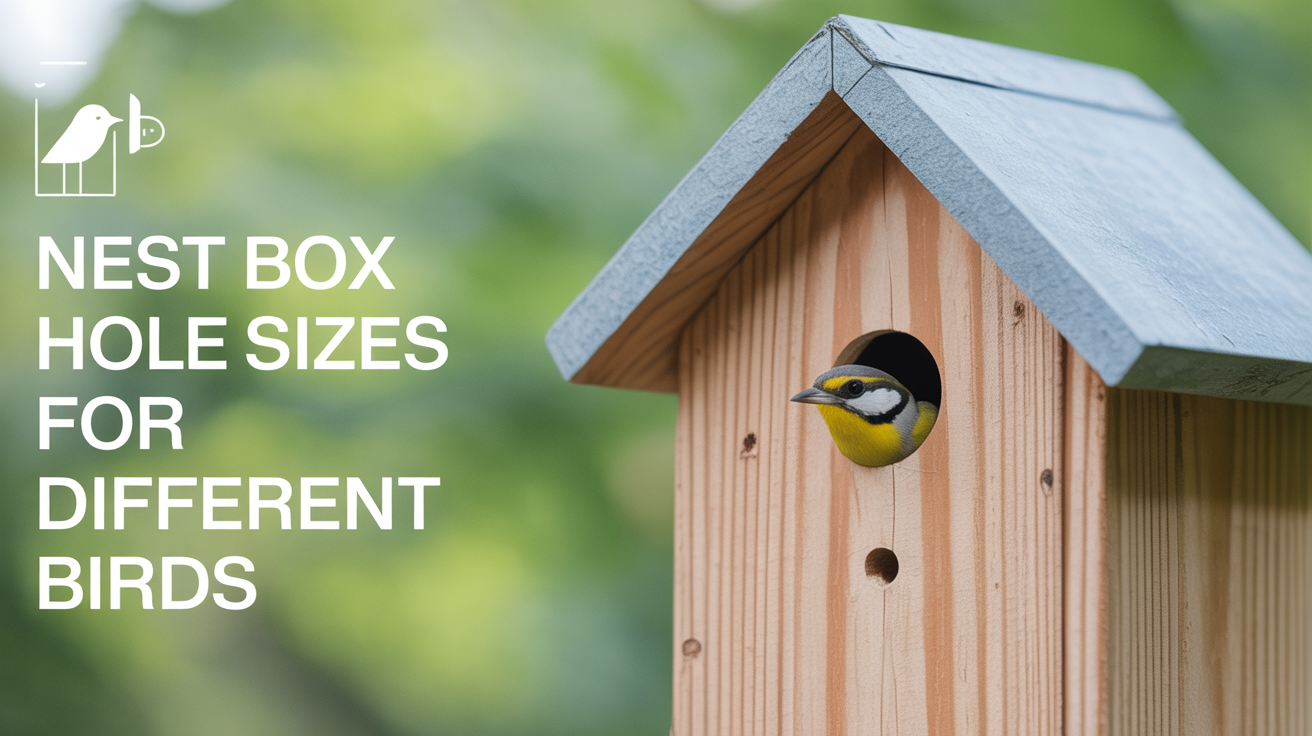
Getting the birdhouse hole size right is one of the most important decisions you'll make when putting up a nest box. The diameter of the entrance hole largely determines which species can move in, and more importantly, which predators and competitor birds cannot. A hole that's 1/8 inch too wide turns a bluebird box into a starling trap.
This guide covers the correct entrance hole diameter, interior floor dimensions, and mounting height for the most common backyard cavity nesters in North America.
Why Hole Size Matters So Much
Cavity-nesting birds evolved to use holes carved by woodpeckers or worn into dead trees by decay. Each species tends to fit snugly through an opening that matches its body width: tight enough to be defensible, wide enough to carry nesting material and food.
When the hole is too large, two problems follow. First, European Starlings (body width requiring about 1.5 inches) can enter almost any box with a hole wider than 1.5 inches, and they're aggressive enough to evict bluebirds, Tree Swallows, and even small woodpeckers. Second, a loose-fitting hole gives raccoons an easier grip on birds and nestlings inside.
When the hole is too small, your target species simply won't use the box, no matter how well-placed it is.
A few species, Tree Swallows in particular, will tolerate a range of hole sizes, but for most cavity nesters the specs below are worth following precisely. A sharp 1-3/8 inch hole saw or spade bit drills clean, accurate holes; a jigsaw or rough auger leaves ragged edges that can injure birds and swell with moisture to unpredictable sizes.
Species-by-Species Hole Size Chart
| Species | Entrance Hole Diameter | Floor Size (in.) | Depth (floor to hole, in.) | Mounting Height (ft.) |
|---|---|---|---|---|
| Eastern Bluebird | 1.5 in. | 5 x 5 | 6–8 | 5–10 |
| Western Bluebird | 1.5 in. | 5 x 5 | 6–8 | 5–10 |
| Mountain Bluebird | 1.5 in. | 5 x 5 | 8–10 | 5–10 |
| Carolina Chickadee | 1.125 in. (1-1/8) | 4 x 4 | 6–8 | 5–15 |
| Black-capped Chickadee | 1.125 in. (1-1/8) | 4 x 4 | 6–8 | 5–15 |
| House Wren | 1.125 in. (1-1/8) | 4 x 4 | 4–6 | 5–10 |
| Carolina Wren | 1.5 in. | 4 x 4 | 4–6 | 5–10 |
| Bewick's Wren | 1.125 in. (1-1/8) | 4 x 4 | 4–6 | 5–10 |
| Tree Swallow | 1.5 in. | 5 x 5 | 6–8 | 5–10 |
| Violet-green Swallow | 1.5 in. | 5 x 5 | 6–8 | 5–15 |
| Tufted Titmouse | 1.25 in. | 4 x 4 | 6–8 | 5–15 |
| White-breasted Nuthatch | 1.25 in. | 4 x 4 | 6–8 | 12–20 |
| Downy Woodpecker | 1.25 in. | 4 x 4 | 8–10 | 5–20 |
| Hairy Woodpecker | 1.5 in. | 6 x 6 | 9–12 | 8–20 |
| Red-bellied Woodpecker | 2 in. | 6 x 6 | 10–12 | 10–20 |
| Northern Flicker | 2.5 in. | 7 x 7 | 13–16 | 6–20 |
| American Kestrel | 3 in. | 9 x 9 | 9–12 | 12–30 |
| Eastern Screech-Owl | 3 in. | 8 x 8 | 10–12 | 10–30 |
| Barn Owl | 6 x 6 oval or 4.5 in. round | 10 x 18 | 12–18 | 15–30 |
| House Sparrow (invasive) | Any 1.75+ in. | n/a | n/a | Avoid |
A note on House Sparrows: they'll use almost any box with a hole 1.75 inches or larger, and like European Starlings they're non-native and not protected under the Migratory Bird Treaty Act. For bluebird and Tree Swallow boxes, the 1.5-inch hole excludes House Sparrows in most regions — though in areas with lots of sparrow pressure, active monitoring is still necessary.
Notes on Specific Species
Bluebirds
Eastern and Western Bluebirds both work well with a 1.5-inch round hole on a box with a 5x5 floor and 6-8 inches of depth from hole to floor. That depth forces the adult birds to cling at the hole and then drop down to reach the nest, which makes it harder for a raccoon to reach the nestlings by extending a paw through the hole.
The North American Bluebird Society publishes detailed plans that have been refined over decades of monitoring. If you're setting up a bluebird trail (a series of boxes in open habitat), their spec is worth following exactly. See where to place a nest box for the best results for spacing and habitat guidance.
Mountain Bluebirds are slightly larger birds and benefit from a bit more depth (8-10 inches), though the hole diameter is the same as for the Eastern.
Chickadees and Titmice
Both Carolina and Black-capped Chickadees use a 1-1/8 inch hole, which is small enough to exclude most competitors. They strongly prefer boxes filled partway with wood shavings (not sawdust) at the start of the season; they'll excavate the shavings to the depth they want, mimicking natural cavity excavation. A box with a bare floor is often passed over.
Tufted Titmice need a slightly larger 1.25-inch hole. In the Southeast, Carolina and Tufted Titmouse can be neighbors on the same property; placing boxes more than 100 feet apart reduces competition.
Wrens
House Wrens are a mixed case. The male builds a "dummy" nest in every available cavity in his territory, sometimes filling multiple boxes with sticks before the female selects one. This can exclude other species from adjacent boxes. The 1-1/8 inch hole suits House Wrens and Bewick's Wrens, while Carolina Wrens (a physically larger bird) need the full 1.5 inches.
Wrens generally prefer boxes lower to the ground and closer to shrubby cover than bluebirds do. A box at 5-6 feet near a brushy fence line is more likely to attract a wren than an open-field bluebird box.
Woodpeckers and Owls
Downy Woodpeckers, the smallest common woodpecker in most of North America at about 6-7 inches long, use a 1.25-inch hole. Hairy Woodpeckers, which look nearly identical but run 9-11 inches, need 1.5 inches and a deeper, wider box. It's a common mistake to put up a small box hoping for a Downy and end up with nothing; woodpeckers are particular about interior volume because they need room to maneuver.
Northern Flickers are big birds, roughly the size of a Robin on a substantial frame, and they require both a 2.5-inch hole and a deep box (13-16 inches from floor to hole). Filling the box with wood chips encourages them to "excavate" and accept the box as natural.
Screech-Owls and American Kestrels both use a 3-inch entrance. Kestrels prefer open country and need the box mounted in a spot with a clear flight path. Screech-Owls are comfortable in wooded suburban yards and will hunt moths, voles, and small birds year-round.
Oval vs. Round Entrance Holes
Most boxes use a round hole, but an oval slot can be useful in specific situations. For bluebird boxes, a 1-3/8 inch tall by 2-1/4 inch wide horizontal oval excludes House Sparrows more effectively than a round hole in high-pressure areas. The oval admits a bluebird's horizontally wider body while blocking the sparrow's rounder profile.
Barn Owl boxes sometimes use a wide oval or a large round opening, but Barn Owls are generally comfortable with either. The floor size and mounting location matter more for Barn Owls than the precise hole shape.
Fitting the Box to the Right Habitat
Even a correctly sized hole won't produce tenants if the box is in the wrong spot. Bluebirds need open fields or short grass, ideally with perching snags or fence posts nearby. Chickadees and titmice want wooded edges with deciduous trees. Tree Swallows want open areas near water. Putting a bluebird box in a dense woodland almost never works, regardless of hole size.
For a full breakdown of mounting heights and habitat per species, the how to build a birdhouse guide covers construction and the nest box placement article covers siting in detail.
Frequently Asked Questions
What is the most common birdhouse hole size?
The 1.5-inch diameter is the most versatile and widely used size. It suits Eastern Bluebirds, Western Bluebirds, Tree Swallows, Carolina Wrens, and Hairy Woodpeckers, while being too small for European Starlings. If you're building a single general-purpose box, 1.5 inches is a reasonable starting point, though a 1-1/8 inch hole is more appropriate if your primary target is chickadees or House Wrens.
Will birds use a hole that's slightly too big?
Sometimes, but with tradeoffs. Chickadees will occasionally use a 1.25-inch hole instead of the ideal 1.125 inches. Bluebirds have been documented using holes up to about 1.75 inches. The real risk is that a larger hole admits competitor species, particularly House Sparrows and starlings, which destroy eggs and kill nestlings. Staying within spec avoids that problem.
Can I add a wooden insert to shrink a hole that's too large?
Yes. A wooden entrance plate (sometimes called a "portal" or "face plate") drilled to the correct diameter can be screwed over an oversized hole. This is a practical fix for repurposing an old box. The plate should be at least 3/4 inch thick to prevent predators from chewing through quickly.
Should I add a perch below the entrance hole?
No. Research on nest box monitoring shows that perches do not increase occupancy rates, and they give House Sparrows a convenient foothold to harass birds exiting the box. Cavity nesters are comfortable clinging to a flat surface and don't need a perch to enter or exit.
How often should I clean out the box between seasons?
Once per year is the minimum, and between each brood if you have multiple nesting attempts per season. Old nesting material can harbor mites, blowfly larvae, and bacteria. Remove the old nest after the young have fledged (typically 16-21 days after hatching, depending on species), and check the hole for any damage or enlargement. See the predator protection guide for advice on checking for signs of predator tampering during the season.