Identifying Birds
How to Tell Backyard Hawks and Birds of Prey Apart
Learn to identify the most common backyard hawks: Cooper's, Sharp-shinned, Red-tailed, and American Kestrel, with field marks beginners can use.
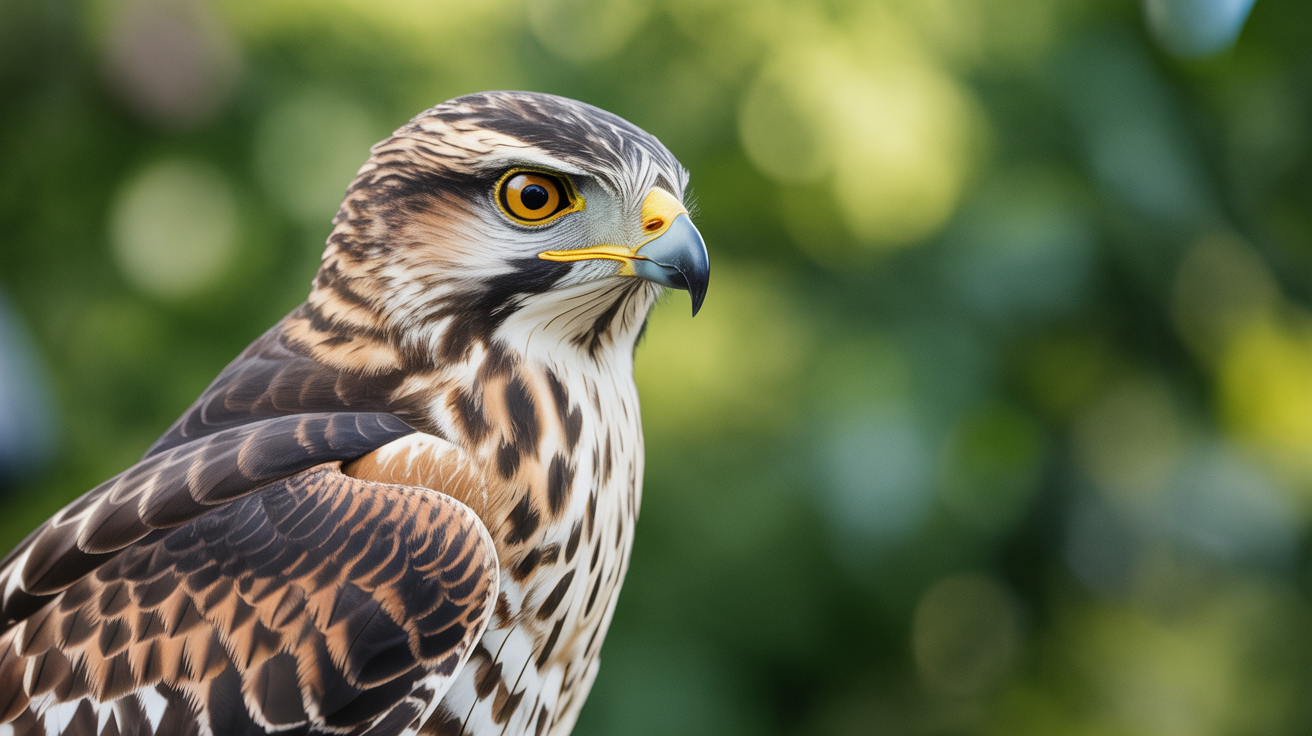
A hawk perched on the fence post or diving through the yard is one of the most dramatic sights in backyard birding, and it is also one of the most misidentified. A few key field marks make the difference between a confident ID and a frustrated guess.
At a Glance
- Wing and tail shape sort raptors into three groups fast: accipiters (Cooper's, Sharp-shinned) have short round wings and long tails, buteos (Red-tailed) have broad wings and short tails, falcons (Kestrel) have long pointed wings, per Audubon's three-part framework for raptor ID.
- Cooper's vs. Sharp-shinned is the classic tough call. Head projection in flight, a Cooper's head sticks out noticeably, a Sharp-shinned's barely does, is the single most reliable cue.
- Red-tailed Hawks are buteos built for soaring over open country; they rarely hunt directly at feeders the way accipiters do.
- American Kestrels are tiny, colorful falcons that hover over open ground and prefer wires and dead treetops to dense shrubs.
- A sudden silence at your feeder, every bird gone at once, is often the first sign a hawk just arrived, not the sound of an attack itself.
- In both accipiter species, females run noticeably larger than males, so size alone is an unreliable field mark on its own.
The Four Hawks You Are Most Likely to See
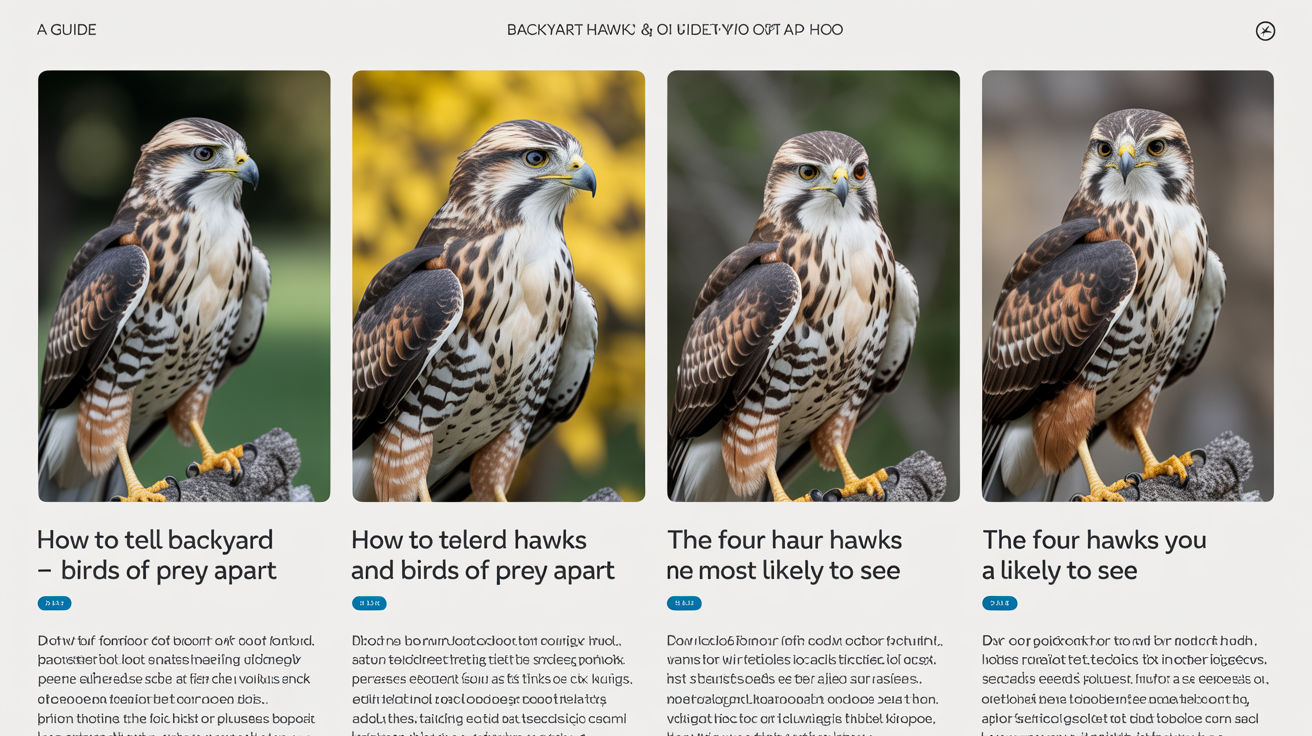
Most backyard birders in North America encounter only a handful of raptor species regularly. Here are the four that show up most often near feeders and suburban yards.
| Species | Wing/tail shape | Typical hunting style | Where you'll see it |
|---|---|---|---|
| Cooper's Hawk | Short rounded wings, long rounded tail | Fast, low ambush through cover, common feeder predator | Trees near feeders, suburban yards |
| Sharp-shinned Hawk | Short rounded wings, square/notched tail | Fast, snappy flight, less predictable feeder visits | Wooded edges, migration corridors |
| Red-tailed Hawk | Broad wings, short wide tail | Soaring, scanning open ground from a high perch or thermal | Open country, larger lots near fields |
| American Kestrel | Long pointed wings, slim body | Hovering over open ground, or watching from a perch | Wires, dead treetops, open grassland |
Cooper's Hawk
Cooper's Hawk is the classic "feeder hawk" across much of the continent. It is a crow-sized accipiter built for hunting birds in dense cover. The adult has a slate-blue back, a rusty-orange barred chest, and a boldly capped head with a pale nape (the back of the neck). The tail is long and rounded, which you will notice especially in flight.
Juveniles are brown above with crisp vertical streaking on the chest, not horizontal bars. Beginners often call juveniles a different species entirely, so check the tail shape and that streaking pattern before moving on.
Cooper's Hawks hunt by flying low and fast through shrubs and trees. If a hawk just scattered every bird at your feeder, Cooper's is the first bird to consider.
Sharp-shinned Hawk
The Sharp-shinned Hawk is the smallest accipiter in North America, roughly the size of a robin or a large thrush. At first glance it looks nearly identical to a Cooper's Hawk, which is why distinguishing the two is one of the most talked-about challenges in birds of prey identification.
Adult Sharp-shinneds have the same rusty-barred chest and blue-gray back as Cooper's, but they are noticeably smaller, with a head that looks small and rounded relative to the body, almost like it barely sits above the shoulders. In flight, the tail appears more square-cut or even slightly notched at the tip rather than rounded.
Juveniles, like Cooper's, are brown with streaked chests, but the streaking tends to look thinner and blurrier.
Red-tailed Hawk
This is probably the most common large hawk in North America and the one most people picture when they think of a hawk. Adults have a brick-red upper tail that catches sunlight beautifully, though you only see it from above or when the bird is perched with its back to you.
From below in flight, look for the dark belly band, a stripe of streaking across the lower chest. The wings are broad and the tail is short and wide. Red-tails are buteos, built more for soaring over open country than threading through trees.
Red-tails do visit yards, especially larger lots near open land, but they rarely hunt at feeders the way accipiters do. A Red-tail perched openly on a light pole or dead snag for long stretches, scanning a field, is a far more typical sighting than one diving through a backyard.
American Kestrel
The American Kestrel is North America's smallest falcon and one of the prettiest birds that might visit a suburban yard. Males have a rust-colored back and tail with blue-gray wings and a distinctive face pattern of two vertical black "mustache" stripes. Females are more uniformly rust-colored, roughly 9 to 12 inches long and slightly larger than males, a size difference typical of falcons generally.
Kestrels hover frequently over open ground while hunting insects and small rodents, sometimes holding almost perfectly still in the air by facing directly into the wind. They prefer perching on telephone wires or dead tree tops, not dense shrubs. If you see a small, colorful raptor hovering above the lawn, it is almost certainly a kestrel.
Cooper's Hawk vs Sharp-shinned: The Trickiest ID in Backyard Birding
If you spend any time reading about birds of prey identification, you will quickly learn that "Coop vs. Sharpie" is a perennial debate even among experienced birders, and Audubon's own beginner's guide to the pair leans on the same handful of field marks described below rather than any single silver-bullet trick. Here are the most reliable ones to focus on.
| Feature | Cooper's Hawk | Sharp-shinned Hawk |
|---|---|---|
| Size | Crow-sized (male smaller, female larger); roughly six inches longer than a Sharp-shinned on average | Robin to jay-sized |
| Head projection | Noticeable; head looks large, projects well past wings in flight | Small; barely projects past the wrists |
| Head shape | Blocky, squared-off, "stacked" look | Small, smoothly rounded |
| Tail tip | Rounded, like the back of a spoon | Square or slightly notched |
| Cap contrast | Strong dark cap, pale nape | Cap blends more with the back |
| Flight style | Flap-flap-flap-glide, steadier flap cadence | Rapid, snappy wingbeats |
| Nape color | Pale/white, creates strong contrast with cap | Less contrast |
A few caveats worth keeping in mind:
- Size is unreliable in the field. Both species show significant size variation between males (smaller) and females (larger). A large female Sharp-shinned overlaps in size with a small male Cooper's.
- Tail shape changes with the molt. Worn feathers can make a rounded tail look square.
- Head projection in flight is often the single most useful cue. A Cooper's looks like it has a real head sticking out in front; a Sharp-shinned looks almost headless.
When you cannot settle on one, it is completely reasonable to record "accipiter sp." in your notes. Many experienced birders do exactly that, and even published field guide authors note that some individual birds are simply not safely identifiable from a single brief look.
How to Read Hawks in Flight
Raptors spend a lot of time in the air, so learning a few basics about flight patterns saves time.
Wing shape separates the major groups. Accipiters (Cooper's, Sharp-shinned) have short rounded wings and long tails. Buteos (Red-tail) have wide, broad wings and short tails. Falcons (Kestrel) have long, pointed wings and a slim body.
Flapping style is another quick cue. Accipiters flap with quick beats in a series, then glide. Buteos soar more, using thermals. Kestrels hover by facing into the wind and rapidly adjusting their wings to stay in place.
Soaring vs. flapping tells you something about hunting strategy. A bird circling lazily overhead on a warm afternoon is likely a buteo looking for prey below. A bird cutting low through the yard is almost certainly an accipiter.
Silhouette beats color at a distance. Once a bird is far enough away that color and pattern are hard to judge, shape alone often gets you to the right group. This is worth practicing on birds you can already identify up close, so the silhouette becomes familiar before you need it on a distant, backlit bird.
If you want to practice these patterns alongside the smaller birds at your feeders, the guide to how to identify common backyard birds covers the songbirds these hawks are chasing.
What Backyard Hawks Are Actually Doing at Your Feeder
Hawks visit feeders because feeders concentrate prey. A yard full of sparrows, finches, and doves is a reliable hunting ground, especially in fall and winter when food is harder to find elsewhere.
Cooper's Hawks are the most consistent feeder visitors of the group. They will perch quietly in a tree near the feeder and wait, then make a fast low pass to catch a bird on the ground or at a platform feeder. The songbirds at your feeder will sound the alarm before you even see the hawk, so a sudden silence followed by every bird disappearing is often your first sign.
Sharp-shinneds visit feeders too, but they tend to be more scattered and less predictable in their patterns, in part because they range more broadly through wooded edges rather than sticking to one territory the way a resident Cooper's Hawk often does.
If a hawk catches a bird in your yard, that is a natural part of the food chain. The hawk needs to eat, and feeder birds accept that risk when they come in to feed. You do not need to take down your feeders. The concentration of birds at a feeder increases predator visits, but it also reflects a healthy and active yard.
For a closer look at the small birds that often share yard space with hawks, the articles on telling common sparrows apart and identifying backyard finches cover the species most likely to show up alongside raptors.
Quick Reference: Field Marks at a Glance
- Cooper's Hawk: crow-sized, rounded tail, pale nape, strong dark cap, head projects noticeably in flight
- Sharp-shinned Hawk: small, square tail, small rounded head, snappy wingbeats, head barely projects
- Red-tailed Hawk: large, brick-red tail (from above), wide wings, belly band, soars on thermals
- American Kestrel: tiny, colorful, hovers over open ground, two "mustache" marks, perches on wires
Frequently Asked Questions
Is the hawk at my feeder going to eat all my birds?
Hawks do catch birds, but they rarely "clean out" a feeder area. They make a pass, usually catch one bird or miss entirely, and then move on. Songbird populations at well-maintained feeders recover quickly. Taking feeders down temporarily after a hawk visit is an option if you prefer, but it is not necessary.
Why do the other birds go silent right before a hawk arrives?
Chickadees, sparrows, and other small birds give sharp alarm calls at the sight of a hawk. The yard goes quiet because every bird hears the alarm and freezes or hides. This response is highly effective. Staying still in dense brush is the best defense a small bird has against a fast accipiter.
Can I tell a Cooper's from a Sharp-shinned from photos?
Photos help a great deal because they let you study the head projection, tail shape, and cap contrast without time pressure. Even so, some birds are genuinely impossible to identify from a single angle. A series of in-flight shots from different angles gives you the best shot at a confident call.
Are Red-tailed Hawks dangerous to pets?
A Red-tailed Hawk can and occasionally does take a small mammal, but attacks on cats and medium-sized dogs are rare. Very small pets (bantam chickens, rabbits left unattended outside) carry more real risk. Supervised outdoor time during daylight hours is the simplest precaution.
What should I do if I find an injured hawk in my yard?
Do not handle the bird. Call a licensed wildlife rehabilitator in your area. Many states have a wildlife rehabilitation hotline, and a quick web search for "[your state] wildlife rehabilitator" will point you to the right resource. Hawks have powerful talons and can injure a person who tries to pick one up without training and proper gloves.
Why are female hawks bigger than males?
In Cooper's Hawks, Sharp-shinned Hawks, and most other raptors, females run noticeably larger than males, the reverse of the size pattern in most bird species. The leading explanation is that it lets a mated pair specialize: the smaller, more agile male can chase down quicker, smaller prey, while the larger female can tackle bigger prey and defend the nest more effectively. It also means the size ranges of the two accipiter species overlap in practice, a small male Cooper's Hawk and a large female Sharp-shinned Hawk end up close enough in size that shape and head projection matter more than a tape measure would.
How do I tell a hawk from a vulture soaring high overhead?
Look at how the wings are held. A Turkey Vulture holds its wings in a shallow V (called a dihedral) and rocks unsteadily from side to side as it soars, almost like it is having trouble staying balanced. A Red-tailed Hawk holds its wings flatter and glides more steadily. Vultures also show a distinctive two-tone underwing, dark in front and pale gray toward the trailing edge and wingtips, that a hawk does not share.