Identifying Birds
How to Identify Common Backyard Birds
Learn to identify the most common backyard birds by size, color, beak shape, and behavior. A practical bird identification guide for beginners.
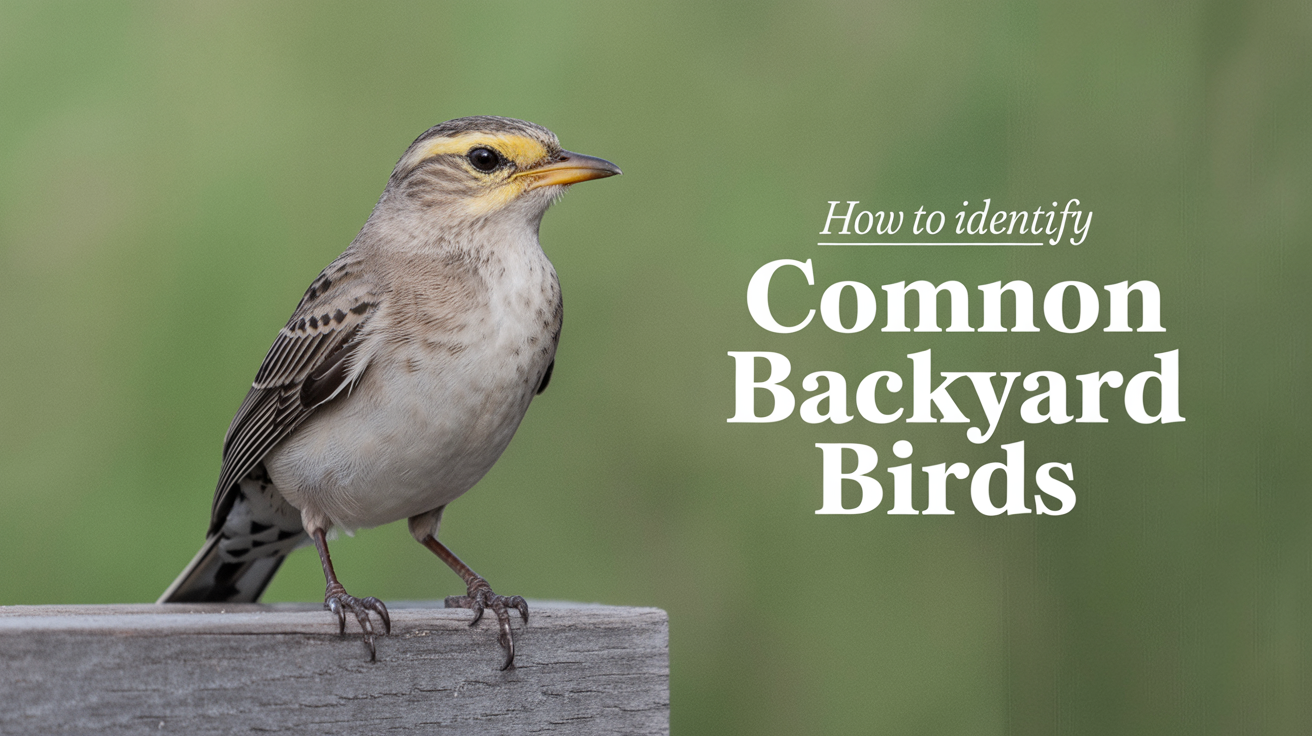
Learning to identify backyard birds is mostly a matter of slowing down and knowing what to look for. Once you can identify backyard birds by a handful of reliable field marks, a chickadee at your feeder stops being "a small gray bird" and becomes a Black-capped Chickadee you'll recognize instantly for the rest of your life.
The good news: you don't need to memorize hundreds of species. A dozen or so birds account for the vast majority of visits to a typical North American backyard feeder, and each one has at least one distinctive feature that sets it apart from the others.
The Four Things to Notice First
Before reaching for a field guide, train your eye to register four details automatically. In rough order of usefulness:
Size and shape. Is it sparrow-sized (about 5–6 inches), robin-sized (about 10 inches), or crow-sized (17–20 inches)? Chunky or slender? Long-tailed or short-tailed? Shape often ID's a bird faster than color, especially in bad light.
Bill shape. A thick, conical bill means seed-cracker (finches, sparrows, cardinals). A thin, pointed bill usually means insect-hunter (warblers, wrens). A straight, dagger-like bill belongs to a woodpecker. Bill shape narrows the family down before you've made out a single color.
Color pattern. Look at the head first, then the wings, then the breast. Don't try to take in everything at once. A single strong mark, like a black cap, a red breast, or white wing bars, is usually enough.
Behavior. Does it hop or walk? Does it creep down a tree trunk headfirst? Does it hang upside-down from a branch tip? Behavior is so consistent within species that experienced birders often ID a bird from movement alone, before they've seen it clearly.
The Most Common Backyard Birds, by Region
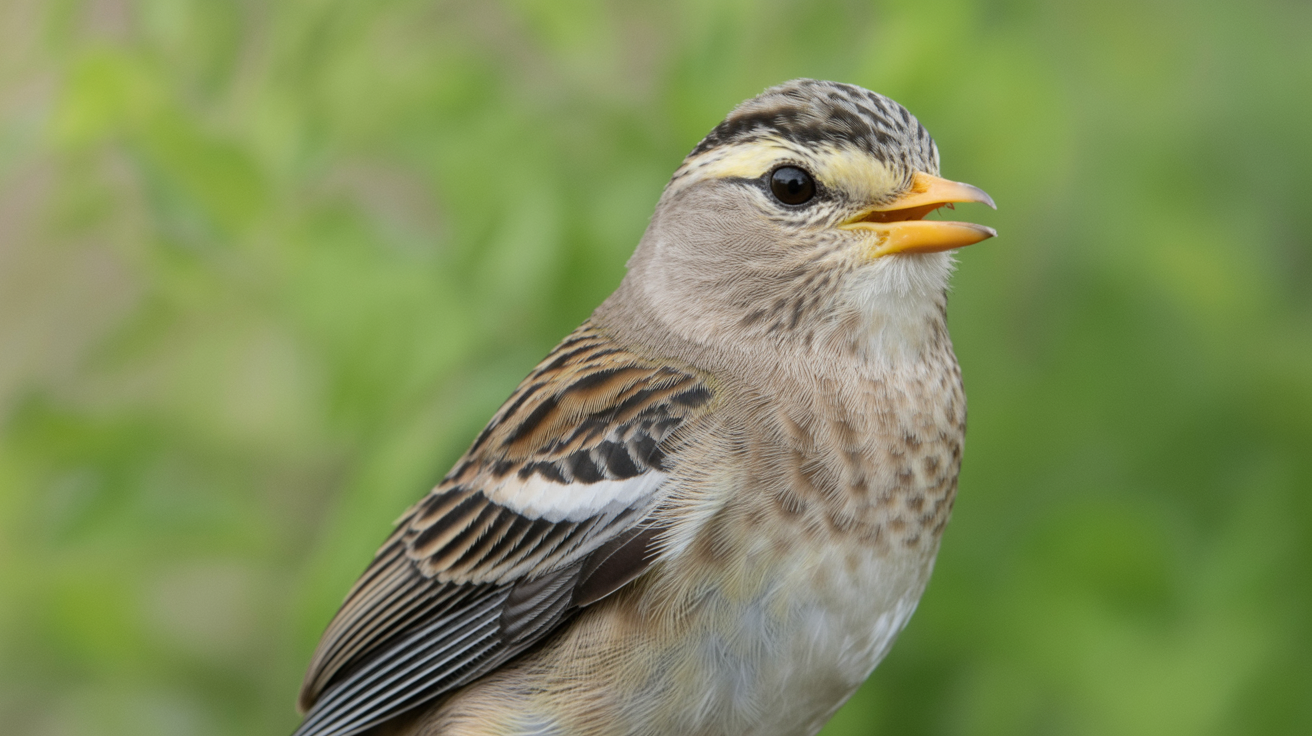
The species below show up regularly across most of the continental United States and southern Canada. Not every bird visits every yard, and the exact mix shifts by region, season, and habitat, but this list covers what most people see at feeders and in nearby shrubs.
| Bird | Key field marks | Feeder food |
|---|---|---|
| Black-capped Chickadee | Black cap + bib, white cheeks, buffy flanks | Sunflower seeds, peanuts |
| Carolina Chickadee | Nearly identical to Black-capped; slightly smaller, less contrast | Sunflower seeds, peanuts |
| American Robin | Brick-red breast, dark gray back, yellow bill | Berries, earthworms (rarely visits feeders) |
| Northern Cardinal | Male: all red, crested, black mask. Female: tan-buff with red tinges, same crest | Sunflower seeds, safflower |
| American Goldfinch | Male in summer: bright yellow + black wings. Winter/female: olive-yellow | Nyjer (thistle), sunflower chips |
| House Finch | Male: red-washed head and breast (variable intensity), brown streaks. Female: plain brown streaks | Sunflower seeds |
| Dark-eyed Junco | Gray or brown body, white belly, white outer tail feathers flash in flight | Millet, sunflower hearts |
| White-breasted Nuthatch | Blue-gray back, white face and breast, rusty flanks, creeps down trunks headfirst | Sunflower seeds, peanuts, suet |
| Downy Woodpecker | Smallest woodpecker, black-and-white checkered, male has red spot on back of head | Suet, sunflower seeds |
| Mourning Dove | Soft tan-gray, long pointed tail, small round head, pink legs | Millet, cracked corn (ground feeder) |
| Blue Jay | Blue above, white below, black necklace, crested; loud and bold | Peanuts, sunflower seeds, acorns |
| House Sparrow | Male: chestnut and black pattern, gray crown. Female: plain buffy-brown, pale eyebrow stripe | Millet, sunflower seeds |
Chickadees: Black-capped vs. Carolina
These two species are so similar that even experienced birders rely on range maps to separate them. Black-capped Chickadees live across northern North America; Carolina Chickadees replace them in the southeastern US. Their ranges overlap in a narrow band running roughly from Kansas to New Jersey, where they interbreed and the call is the most reliable separator. Black-capped gives a two-note whistle that sounds like "fee-bee." Carolina's song is a four-note "fee-bee fee-bay," faster and higher-pitched.
Finches: How to Sort the Red Ones
House Finches are common across the whole country. Purple Finches are similar but have a raspier call and a more wine-soaked, less orange-y red on the male, with a strong white eyebrow stripe on the female. Cassin's Finch turns up in western mountain areas.
The easiest way to sort them: if you're east of the Rockies and see a red-headed finch at your feeder, it's almost certainly a House Finch. If you're in the West, all three are possible, so look at the female. A House Finch female has fine brown streaks and no strong face pattern. A Purple Finch female has a bold white supercilium (eyebrow) and a dark cheek patch that makes her look sharp-faced.
For a deeper look at these species, see Identifying Backyard Finches: Goldfinch, House, and Purple.
Woodpeckers: Downy vs. Hairy
These two species are black-and-white twins. The Downy Woodpecker is sparrow-sized (about 6–7 inches); the Hairy Woodpecker is robin-sized (about 9–10 inches). When they're not side by side, size is tricky to judge. The reliable separator: bill length relative to head width. The Downy's bill looks almost dainty, shorter than the width of its head. The Hairy's bill is long and chisel-like, roughly as long as its head is wide. When you see one at your suet feeder, that bill proportion is the first thing to check. For a more complete treatment of all the woodpecker species that visit feeders, Woodpeckers at Your Feeder: A Field Guide covers Red-bellied, Pileated, and others beyond the Downy/Hairy pair.
Using Songs and Calls
Backyard bird identification gets dramatically easier once you start recognizing voices. Many common species have songs simple enough to learn in an afternoon:
- Black-capped Chickadee: its own name, "chick-a-dee-dee-dee," plus a clear two-note whistle "fee-bee"
- American Robin: a rich, rolling carol, often described as "cheerily cheer-up cheerio," sung mostly at dawn and dusk
- Northern Cardinal: a loud, clear "cheer cheer cheer" or "pretty-pretty-pretty," one of the few species where the female sings too
- American Goldfinch: a bright, bouncy "per-CHIK-o-ree" in undulating flight
- White-breasted Nuthatch: a nasal "ank ank ank," often rapid, as it works down a tree
- Mourning Dove: a low, mournful "ooo-woo woo woo" that's sometimes mistaken for an owl
The Cornell Lab's Merlin app (free, iOS and Android) has a Sound ID feature that identifies birds from live audio in real time. Running it in your backyard for even fifteen minutes will teach you more than a week of looking at pictures.
Putting It Together: A Practical Identification Routine
When a bird lands at your feeder or in a nearby shrub, run through these steps before it leaves:
- Note size immediately, before anything else. Compare it mentally to a species you already know.
- Look at the head. Cap color, eye stripe, eye ring, bib, and bill shape are almost always visible.
- Check the wings for wing bars, patches, or a distinctive pattern.
- Watch it move for a few seconds. Does it pump its tail? Does it hang upside-down? Does it walk or hop?
- Note the habitat. A bird skulking in dense shrubs at ground level is probably not the same species as one working the tips of high branches, even if they look similar in size.
Don't worry about nailing the ID instantly. Write down what you saw, make a sketch if that helps you, and look it up afterward. That process of reconstructing a bird from memory is exactly how experienced birders train their observation skills.
Sparrows deserve a special mention here because beginners often find them frustrating, a group of "little brown jobs" that all look alike. They're actually quite separable once you know which field marks to look for. Song Sparrows have a central breast spot and heavy streaking; White-throated Sparrows have a clean white throat patch and yellow lores; Fox Sparrows are much larger and rusty. The trick is to pick one feature per species and look for that first. A full breakdown of the most common species is in How to Tell Common Sparrows Apart.
Field Guides and Apps
The two print field guides most commonly recommended for North American birders are the Sibley Guide to Birds and the National Geographic Field Guide to Birds. Both cover every species you're likely to see; the Sibley shows multiple plumages per species while the National Geographic is slightly more compact. Either works fine for backyard use.
For a phone, Merlin Bird ID (Cornell Lab) is the clear first choice: it has point-and-click ID, photo ID, and Sound ID, covers North America thoroughly, and is free with no in-app purchases. eBird (also Cornell) is worth adding once you want to start logging what you see and comparing with what others are finding nearby.
You don't need both a print guide and an app, but having the print guide open on a windowsill while you watch the feeder is a satisfying way to work through an ID, and you're more likely to actually absorb the field marks that way.
Frequently Asked Questions
How do I identify a bird I've never seen before?
Start with size and bill shape, which together usually narrow it to a family (woodpecker, finch, sparrow, thrush, etc.). Then look at the head for any strong marks: cap color, eye stripe, bib, throat color. The Merlin app's photo ID function can help if you get a photo, but even a rough description, "sparrow-sized, streaky brown, strong white eyebrow, seed-eating bill," will point you to the right section in any field guide.
What's the easiest backyard bird to identify?
The Northern Cardinal is probably the most straightforward: a male Cardinal's all-red plumage and prominent crest are unlike anything else in North American backyards. Blue Jays and American Robins are close runners-up. Chickadees are also distinctive once you've seen that black-cap-and-bib pattern even once.
Why do female birds look so different from males?
In many species, the male's bright coloring serves to attract mates, while the female's duller plumage helps her blend into the background while she's incubating eggs, which reduces predation risk. This pattern is common in songbirds (cardinals, goldfinches, House Finches) but absent in others like American Robins and Blue Jays, where both sexes look similar.
Is it okay to photograph birds to help identify them?
Yes, a photo is often the best way to work through a tricky ID later at your desk. Keep in mind that getting close enough for a clear photo can disturb nesting birds, so maintain a reasonable distance, especially during breeding season. A photo from a window feeder is ideal because the glass provides a barrier that the birds seem less bothered by than an open-air approach.
How long does it take to get good at bird identification?
A few dozen hours of deliberate watching, spread over a few weeks, is usually enough to get confident with the 15–20 most common backyard species. The shift from "I sort of know what that might be" to "I know exactly what that is" happens pretty fast once you start paying attention to size and bill shape first. Knowing the songs helps enormously and cuts the time down further.