Identifying Birds
Identifying Backyard Finches: Goldfinch, House, and Purple
Learn to tell apart the three most common backyard finches (American Goldfinch, House Finch, and Purple Finch) by plumage, size, bill shape, and song.
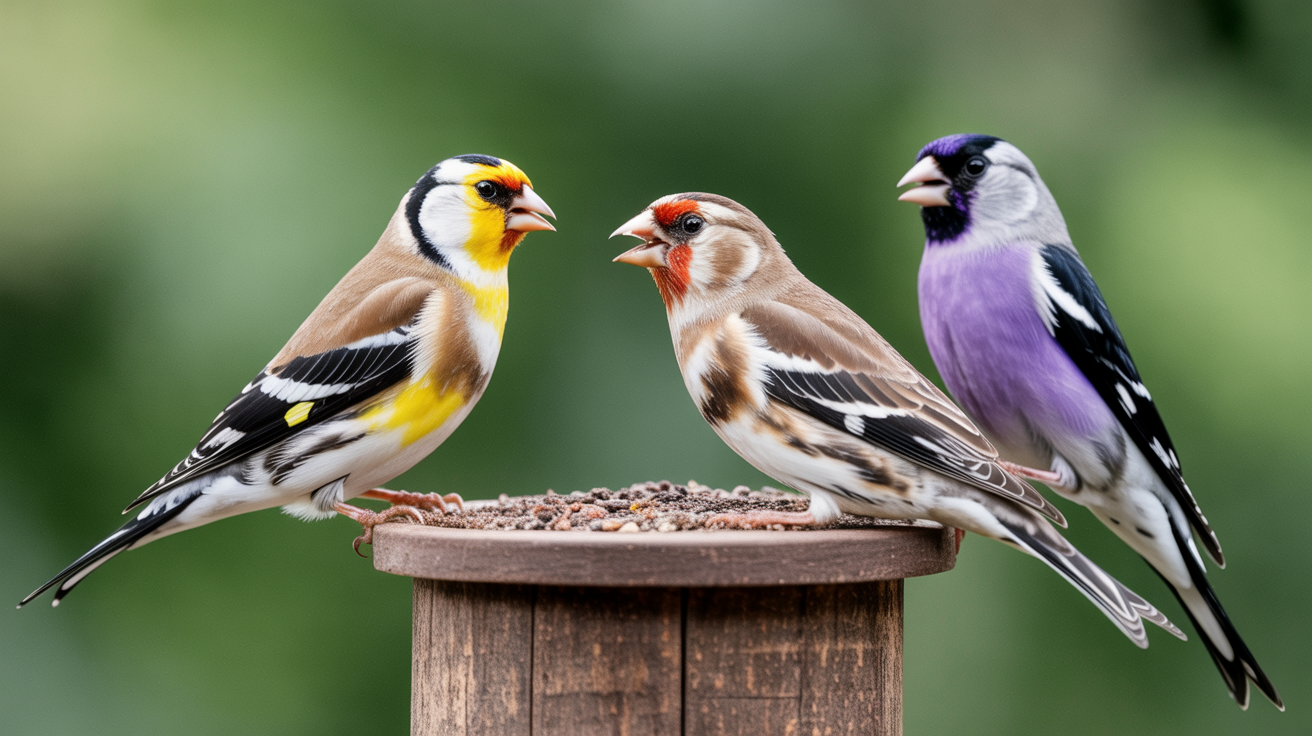
If you're trying to sort out the types of finches showing up at your feeders, you've probably stared at a small red-streaked bird and wondered: house finch or purple finch? These three species (American Goldfinch, House Finch, and Purple Finch) account for the vast majority of finch sightings across North America, and once you know what to look for, telling them apart is more satisfying than it first seems.
American Goldfinch: The Easy One (Most of the Year)
The American Goldfinch (Spinus tristis) is probably the most straightforward of the trio, at least from April through September. Males in breeding plumage are a saturated canary yellow with jet-black wings and a black cap. There's really nothing else in most yards that looks like that.
The tricky part is winter. By November, that bold yellow has molted into a dull olive-buff, the black cap is gone, and the male looks a lot like the female does year-round: yellowish-green above, paler below, with two white wingbars. Many beginners see a winter goldfinch and don't recognize it.
What to look for regardless of season:
- Small, compact body (about 4.5 inches, noticeably smaller than a House Sparrow)
- Short, conical, pale pinkish bill, stubby and purpose-built for tiny seeds
- Bold white wingbars on black wings, present all year
- Deeply undulating flight pattern, often accompanied by a per-chick-o-ree call
- Yellow-green color anywhere on the body (even in winter they're more yellow-toned than sparrows)
Goldfinches are strongly associated with nyjer (thistle) seed and will sometimes bypass other feeders entirely to reach a nyjer tube. They're late nesters, often not building until mid-summer when thistle plants go to seed, so don't be surprised if they're at your feeder in July while other songbirds are already feeding fledglings.
House Finch: Streaky Red, Common Everywhere
The House Finch (Haemorhous mexicanus) is the one most people see first. Originally a western species, it was introduced to New York in the 1940s and has since spread across virtually all of the lower 48 states. It's comfortable at tube feeders, on platform feeders, and nesting in hanging baskets on your porch.
Adult males have a reddish-orange wash concentrated on the head, breast, and rump, with heavy brown streaking on the flanks. The key word is "streaky": the red sits on top of a streaked base, so even the red parts show darker lines running through them.
Females are plain brown with blurry streaking overall and no bold facial markings. They look similar to several sparrows, which is why the male's coloration matters for initial identification.
Reliable House Finch features:
- Reddish-orange (sometimes almost orangey-yellow) concentrated on face and breast
- Streaked flanks even where red is present
- Rounded head, no crest
- Curved culmen (the top of the bill curves downward slightly rather than being straight)
- Cheerful, rambling warble that rises and falls; song often ends on a nasal, buzzy note
One honest caveat: House Finch males vary considerably in color intensity. Diet during molt influences the pigment, and birds that eat more carotenoid-rich foods get brighter red. A pale House Finch can be puzzling. Check the bill shape and streaked flanks first.
Purple Finch: The One People Overlook
The Purple Finch (Haemorhous purpureus) is less common at suburban feeders than the House Finch but turns up regularly, especially during fall and winter when birds move south from their northern breeding grounds in Canada and the northern U.S. It's also a year-round resident in the Pacific Northwest and parts of New England.
Despite the name, males aren't purple. Roger Tory Peterson described them as looking like a sparrow dipped in raspberry juice, which is actually more accurate. The red is richer, deeper, and more uniformly distributed than on a House Finch. Critically, the male Purple Finch has much less flank streaking, and the red extends more thoroughly into the back and wings.
How to separate Purple Finch from House Finch:
| Feature | House Finch | Purple Finch |
|---|---|---|
| Male color | Orange-red, streaky | Deep raspberry, less streaky |
| Flanks | Clearly streaked brown | Faint or clean |
| Back | Brown, streaked | Washed with red/wine |
| Bill shape | Curved culmen | Larger, more triangular |
| Facial pattern (female) | Plain, blurry streaks | Bold white eyebrow stripe |
| Tail | Slightly notched | More deeply notched |
| Body size | Smaller, ~6 in | Slightly larger, ~6.25 in |
The female distinction is actually cleaner than the male: female Purple Finches have a crisp white supercilium (eyebrow stripe) and a dark brown cheek patch bordered by a whitish malar stripe. Female House Finches lack these markings and are just plain streaked brown. If you can see the face clearly, you'll know.
During winter irruption years — when conifer cone crops fail in the north — Purple Finch numbers at feeders can spike dramatically. Purple Finches prefer black-oil sunflower seed and will feed alongside House Finches and goldfinches without much fuss.
Comparing All Three at the Feeder
When multiple finch species are present at once, a few quick checks narrow things down fast:
- Yellow anywhere? Goldfinch. No other backyard finch shows yellow.
- All-brown with blurry streaks, no color? Female House Finch, or (with white eyebrow stripe) female Purple Finch.
- Red or orange color on a male? Compare the bill curvature and flank streaking to separate House from Purple.
- How many white wingbars? Goldfinches have two sharp white wingbars on black; the other two show wingbars too but on brown wings, and they're less contrasted.
Song is genuinely useful once you're familiar with it. American Goldfinch sings a long, canary-like warble with frequent potato-chip or per-chick-o-ree contact calls in flight. House Finch has a shorter, lively warble that ends in that distinctive buzzy note. Purple Finch sings a richer, faster warble without the buzzy ending, often compared to a recording of the House Finch played at slightly higher speed.
If you're building your ear for finch songs, free apps like Merlin Bird ID (Cornell Lab) let you record a bird calling and get an instant ID suggestion. It's not a substitute for learning the songs yourself, but it's a legitimate aid while you're still learning. For a broader look at separating look-alike species, the guide to common backyard birds covers the habitat and behavior cues that often matter as much as plumage.
What Finches Actually Eat (and What Draws Them)
All three species will take black-oil sunflower seeds, which is the single most useful thing to put out if you want finches. Beyond that, preferences diverge:
- American Goldfinch: Strongly prefers nyjer seed and small millet. A dedicated nyjer tube with small ports keeps goldfinches happy and mostly excludes larger birds. They'll also work through sunflower chips.
- House Finch: Generalists. They eat sunflower, safflower, millet, and will work through mixed seed blends. They're among the more adaptable feeder birds.
- Purple Finch: Sunflower is the main draw. They're less consistent visitors than House Finches and tend to move through in small groups during fall and winter rather than setting up territory at a single yard.
Thistle socks (those mesh bags sold for nyjer) work fine but get moldy in wet weather faster than tube feeders with proper drainage holes. If you're in a rainy climate, a covered nyjer tube is worth the $20-30 investment.
If you find yourself wanting to distinguish the finches from the many other streaky brown birds that show up, the breakdown of common sparrows handles the most frequent points of confusion — sparrow vs. finch is a question nearly every beginner hits within the first few weeks.
Frequently Asked Questions
Why does my "goldfinch" look dull green instead of bright yellow?
American Goldfinches molt twice a year. By October, males have replaced their bright breeding plumage with a duller, olive-buff winter coat. Females look similar year-round. The white wingbars on black wings persist through all plumages and are the most reliable constant field mark. If you see those wingbars paired with any yellow-green tones, it's almost certainly a goldfinch.
My House Finch looks more orange than red. Is something wrong with it?
Probably not. Male House Finches get their red color from carotenoid pigments in their food during the molt before their first breeding season. Birds that had access to more carotenoid-rich food (certain berries, insects) develop deeper red; birds on a leaner diet can come out orangey or even yellowish. It's normal variation, not illness.
How do I tell a Purple Finch from a House Finch when the male's color isn't obvious?
Focus on the female if you can see her. The bold white eyebrow stripe on a female Purple Finch is the cleanest single field mark. On males, check the flanks: House Finch males nearly always show distinct brown streaking on the sides even where red is present, while Purple Finch flanks are faint or clear. Bill shape helps too, since the House Finch bill has a notably curved upper edge.
Do finches use nest boxes?
No. All three species are open-cup nesters. House Finches will nest in hanging baskets, dense shrubs, ivy on a wall, or in the cavity of a hanging plant container, but they don't use standard nest boxes. American Goldfinches build in shrubs and small trees, typically 4-15 feet up, using plant down (especially thistle or cattail fluff) to form a tight cup. If you want to attract them to nest, planting native shrubs and leaving thistles to go to seed in a corner of the yard is more effective than any box.
Can finches spread disease at feeders?
House Finches are susceptible to Mycoplasmal conjunctivitis, a bacterial eye infection that causes swollen, crusty eyes and can spread between birds at shared feeders. If you see a finch with a visibly swollen or weeping eye, take down and thoroughly clean your feeders with a 10% bleach solution, let them dry fully, and wait a day or two before putting them back out. You can't treat wild birds directly; contact a licensed wildlife rehabilitator if you're concerned about a specific bird that appears unable to fly or feed. Cleaning feeders every one to two weeks in normal conditions is the best preventive measure regardless of whether you see sick birds.