Getting Started
How to Keep a Backyard Bird Journal and Life List
Learn how to keep a bird watching journal and life list that actually helps you learn faster, spot patterns, and remember every bird you've seen.
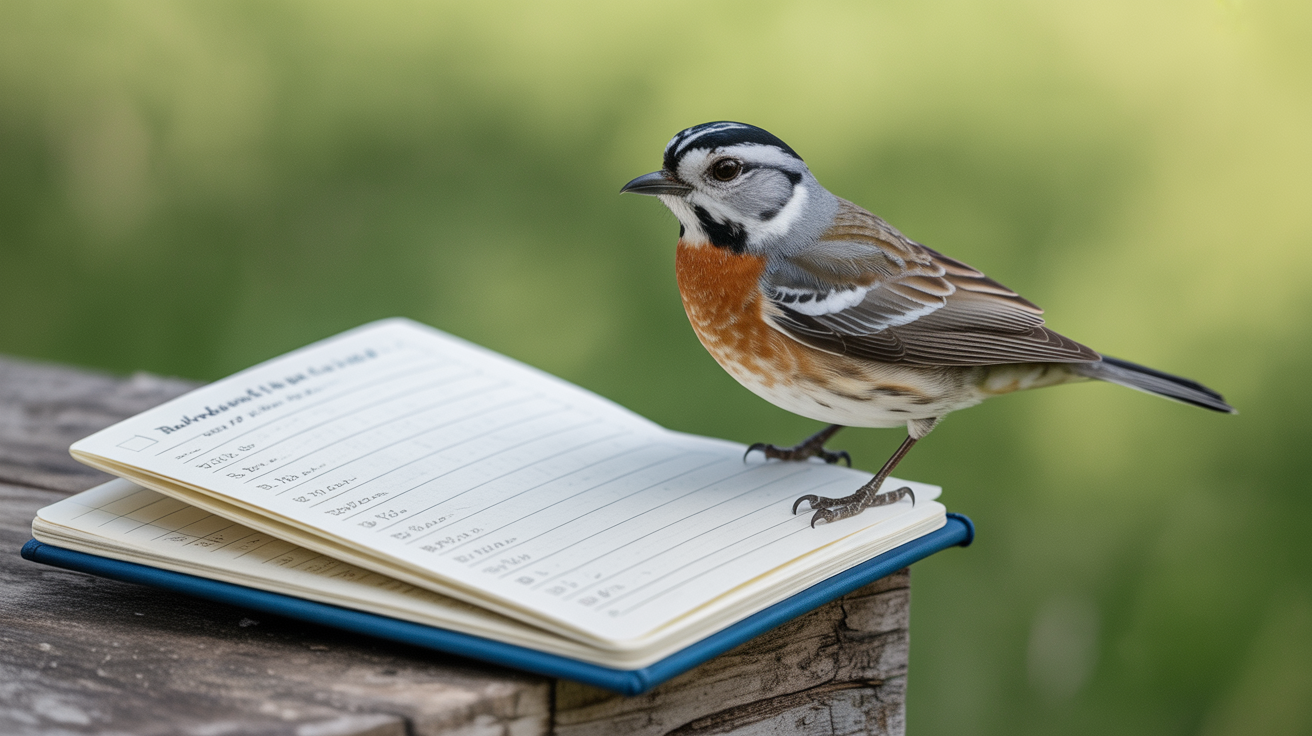
A good bird watching journal does two things at once: it makes you a sharper observer in the moment, and it builds a personal database you'll actually want to revisit years from now. Whether you use a pocket notebook, a dedicated birding app, or a plain spreadsheet, the habit of writing things down transforms casual feeder-watching into something much more satisfying.
What Goes in a Bird Journal Entry
Every entry needs four basics: date, location, species, and a brief note about what you actually saw or heard. That's the floor. Everything else is optional, but the extras are usually what make old entries fun to read.
A complete entry might look like this:
- Date and time: June 1, 2026, 7:15 a.m.
- Location: Back porch, west-facing feeder, Cedar Rapids IA
- Species: Male Rose-breasted Grosbeak
- Count: 1
- Behavior: Eating black-oil sunflower seed; chased off by a House Finch after about 90 seconds
- Field marks: Rose-red triangle on chest, white wing patches, heavy pale bill
- Conditions: Overcast, 58°F, light southeast wind
The behavior note is the part most beginners skip, and it's often the most useful. "Eating" tells you almost nothing. "Cracking open sunflower seeds and dropping the hulls, then flying to the maple to eat" tells you something about how the bird uses your yard.
Weather and wind direction matter more than they seem. Songbird activity at your feeders often spikes right before a cold front. If you write down the conditions, you'll start to notice those patterns within a season or two.
Setting Up a Life List That Works for You
A birding life list is simply a running tally of every species you've confirmed seeing or hearing. The classic format is a numbered list with the date and place of your first sighting. Some listers add a brief note; many don't. The structure can be as loose or strict as you want.
A few decisions to make when you start:
What counts as a confirmed sighting? Most birders require a good enough look to identify the bird with reasonable confidence, not just a fleeting glimpse or a partial silhouette. You can keep a separate "probable" list for the ones you're not quite sure about.
Does a heard-only bird count? Traditionally, yes, as long as you were confident enough in the identification to claim it. A Carolina Wren singing from dense cover is still a Carolina Wren. A mysterious chip note that might have been a redpoll, probably not.
Which taxonomy do you follow? The American Birding Association (ABA) and Cornell Lab's eBird both use the Clements checklist, updated annually. Following one standard taxonomy keeps your list consistent and makes it easier to compare with other birders.
| List type | What it tracks | Good for |
|---|---|---|
| Life list | Every species, ever, anywhere | Long-term milestones |
| Year list | Species seen in a calendar year | Annual rhythm, friendly competition |
| Yard list | Species seen from or on your property | Tracking your own habitat |
| Month list | Species seen in a single month | Phenology, migration windows |
| Big day list | Species seen in a 24-hour window | Challenge birding |
Most backyard birders run a life list and a yard list simultaneously. The yard list is often more personally meaningful because you build it over years of watching one specific place change.
Paper vs. App: Honest Tradeoffs
Neither medium is objectively better. Most serious birders use both.
Paper notebooks are fast to grab, never need charging, and hold up at the feeder in rain or cold. Spiral-bound field notebooks in 3.5 x 5.5 inch size fit a shirt pocket. The main downside: searching old entries is slow, and you can't generate automatic totals or maps.
eBird (Cornell Lab, free) is by far the most widely used digital option. You log a checklist for each outing, your data feeds into a global science database, and the platform automatically maintains your life list, year list, and yard list. The interactive bar charts show you which species visit in which months, which gets genuinely useful after a year or two of data. The tradeoff is that eBird's interface rewards complete checklists of all species seen, which is more effort than jotting a quick note.
Merlin Bird ID (also Cornell, free) isn't a journal per se, but its Sound ID feature can identify birds by song in real time and will save a log of what it heard. Paired with eBird, it handles a lot of the identification work.
If you're just starting out, the lowest-friction setup is a paper notebook at the feeder and eBird for anything you want to keep long-term. You can always transcribe later.
For a deeper look at the gear side of getting started, see The Beginner Birder's Starter Kit: What You Actually Need.
Using Your Journal to Actually Learn More Birds
A journal only improves your birding if you go back and read it. A few habits that help:
End-of-month review. Spend 15 minutes at the end of each month skimming your entries. What did you see most? What did you miss that you expected? Did anything show up that surprised you?
Sketch the confusing ones. You don't need to be an artist. A rough outline with labeled field marks forces you to articulate what you saw, which is the mental step most people skip. A bad sketch of a confusing Empidonax flycatcher is worth more than a detailed memory of one you didn't bother to draw.
Flag your first-of-year birds. Mark the date of your first American Robin each spring, your first Indigo Bunting, your first Chimney Swift. After three or four years you'll have your own phenology calendar, which is far more useful than any generic regional average.
Note what you got wrong. If you called a bird a House Finch and later decided it was a Purple Finch, write that down. Tracking your own errors is uncomfortable but it's how identification skills improve. (If sorting out those two gives you trouble, the guide on identifying backyard finches covers the key differences in detail.)
Yard Journal: Going Beyond Species Lists
A yard list is a species count. A yard journal is a portrait of a place. The two overlap, but the journal can hold things a list can't.
Some categories worth tracking in a yard-specific journal:
- First and last dates for migratory species (Yellow-rumped Warblers, White-throated Sparrows, Ruby-throated Hummingbirds)
- Breeding evidence: Did the House Wrens actually nest in the box? How many fledglings did you count?
- Feeder activity patterns: Which feeder gets the most use by time of day? What changes when you switch seed types?
- Weather-linked observations: Which species disappear during heat waves? Which show up right after a storm?
- Plant connections: Which fruit-bearing shrubs drew the most Cedar Waxwings? Did the sunflowers you let go to seed bring American Goldfinches in August?
A yard journal built over several years becomes a genuinely useful ecological record. You'll know your yard better than any field guide can, because you're watching one specific patch in all seasons and conditions.
Frequently Asked Questions
Do I need to start with eBird, or can I keep a paper list forever?
A paper list is completely legitimate and many experienced birders still prefer it. You lose the automatic totals and the data contribution to science, but you gain flexibility and simplicity. Some people maintain a handwritten life list for decades and only add eBird later as a supplement. Start with whatever you'll actually use.
How do I handle birds I can't identify?
Make a note anyway. Write down every field mark you could see, the size relative to a known species, the habitat, the behavior. You can look it up later or post the description to a local birding group. An honest "unidentified sparrow, medium size, streaked breast, pumped its tail" is more useful than nothing.
Should I count birds at my feeder differently from birds in the rest of my yard?
That's a personal choice. Some birders keep a strict "feeder list" separate from a general yard list because feeder birds are drawn in artificially. Others count anything seen or heard on the property. For a life list, the convention is clear: a bird at a feeder counts. For a yard list, decide your own rules and apply them consistently.
How granular should my counts be?
As granular as is useful for you. At a busy feeder in winter you might write "15+" House Sparrows rather than trying to count every individual. eBird encourages actual numbers because the data is more scientifically useful, but for a personal journal, "several" or "flock of ~30" is fine. Accuracy about what you actually observed is more valuable than precision you invented.
When does a yard list get "good"?
There's no threshold, but a yard list starts to feel meaningful somewhere around 50 species, at which point you've documented a real range of habitat use across seasons. Well-situated suburban yards with a mix of feeders, water, and native plantings typically reach 80-120 species over several years. Some exceptionally placed properties in migration corridors have topped 200. The number matters less than the knowledge you've built to get there.
If you're still setting up the basics, How to Start Backyard Birding: A Beginner's Guide covers the foundational steps before you start logging anything.