Getting Started
The Beginner Birder's Starter Kit: What You Actually Need
Backyard birding equipment doesn't need to be expensive. Here's what actually matters for beginners, and what you can skip.
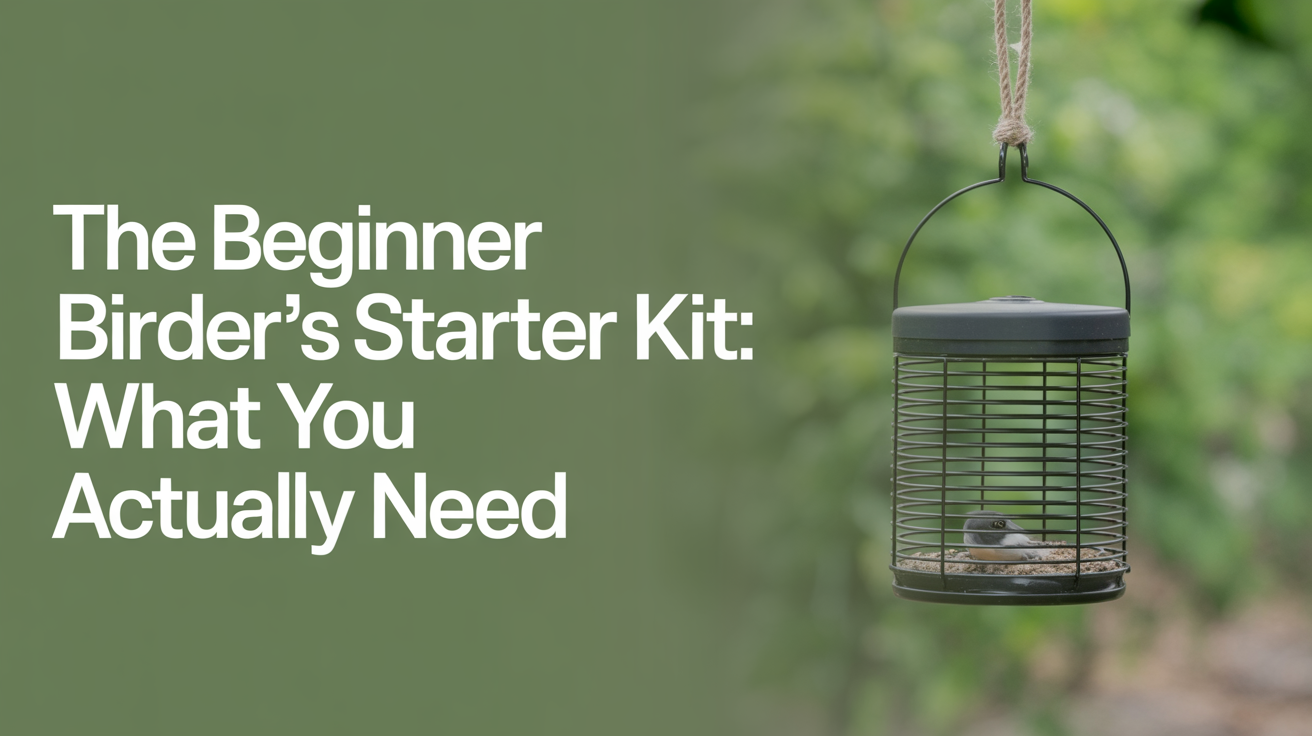
Most people who get serious about backyard birding started with whatever binoculars were in the closet and a printed checklist from a nature center. The gear matters, but not as much as the industry would have you believe. The short answer: you need decent optics, a field guide suited to your region, and somewhere comfortable to sit. Everything else is optional.
That said, choosing the right backyard birding equipment from the start saves frustration later — a pair of binoculars with a narrow field of view will make you miss half the birds that dart through your yard.
Binoculars: The One Thing Worth Spending On
Binoculars are the single piece of kit that actually changes what you see. For backyard use, an 8x42 configuration is the standard recommendation for good reason: the 8x magnification gives a wide enough field of view to track moving birds, and the 42mm objective lens gathers enough light for early-morning and overcast sessions.
What to look for:
- Close focus distance. Backyard birds often land within 10–15 feet. Many binoculars can't focus closer than 8–10 feet, which matters a lot if a warbler lands on the feeder right in front of you. Check the spec before buying.
- Eye relief. If you wear glasses, look for at least 15mm of eye relief so you can see the full image without pressing the eyecups to your face.
- Twist-up eyecups. They hold the correct eye distance without you having to think about it.
Price reality: under $75, most binoculars have poor edge sharpness and dim images in shade. The $100–200 range (Nikon Prostaff, Celestron Trailseeker, Vortex Crossfire) represents a genuine quality jump. Above $400, you're buying glass quality that makes a real difference at dusk or in dense cover — worth it if this becomes a serious hobby, but not necessary for the yard.
For a deeper comparison of magnification and lens specs, see our guide to choosing binoculars for birdwatching.
A Field Guide You'll Actually Use
A field guide is still more practical than an app when you're standing at the window trying to match a bird you just saw. The physical book stays open to the right page.
Two guides dominate beginner recommendations in North America:
| Guide | Strengths | Tradeoffs |
|---|---|---|
| Sibley's (regional editions) | Detailed artwork showing age/sex variation; excellent range maps | Heavier; can be overwhelming at first |
| Peterson's | Classic pose-based layout easy to scan; compact | Artwork style feels dated to some; less detail on subspecies |
| Kaufman Field Guide | Photo-based; often easiest for true beginners | Photos vary in quality; fewer species covered |
| Merlin (Cornell Lab app) | Sound ID is excellent; always updated | Requires phone; harder to use mid-observation |
The regional editions of Sibley's (Eastern, Western) are worth the extra $5 over the full continental edition — fewer irrelevant species to flip past, and the plates are a bit larger. If you're in the Southwest or coastal California, those regions have genuinely different bird pools and the regional guide earns its keep.
Merlin's sound ID works well for learning songs but shouldn't replace a guide for visual ID practice. Using both is the move.
A Feeder or Two (Not Six)
Beginners often put up too many feeders at once, then get overwhelmed by refilling and cleaning. Start with one tube feeder for black-oil sunflower seed and add a suet cage if you have any trees nearby. That combination covers the broadest range of common species: chickadees, nuthatches, titmice, finches, cardinals, and woodpeckers.
Tube feeders with metal ports hold up longer than pure plastic, which squirrels crack open within weeks. A basic metal-port tube feeder runs $20–40 and lasts years.
What you don't need at the start:
- Nyjer/thistle feeders (worth adding later if goldfinches visit, but thistle goes rancid fast)
- Hummingbird feeders (highly seasonal; requires diligent cleaning every 2–3 days in warm weather)
- Peanut feeders (attracts jays and woodpeckers, great addition later)
A location note: 3 feet or closer to a window, or more than 30 feet away, both reduce window strike risk significantly. The danger zone is the 4–30 foot range where birds have enough speed to injure themselves on glass. Window decals or tape strips spaced 2–4 inches apart on the outside of the glass help a lot if you can't adjust placement.
A Notebook and a Consistent Spot
This sounds low-tech, but keeping a simple log (date, time, species seen, weather, notes) builds pattern recognition faster than any app. You start noticing that the White-throated Sparrows show up every October and leave in April, or that the Cooper's Hawk visits between 7 and 9am most mornings in winter.
A $3 composition notebook works fine. Some people eventually migrate to eBird (Cornell Lab's free checklist tool), which automatically maps your sightings and contributes to citizen science data. Either way, the habit of recording matters more than the tool.
What You Can Skip (For Now)
A spotting scope. Scopes are for open-field birding: shorebirds, raptors circling at distance, waterfowl on a lake. For the backyard, they're more trouble than they're worth.
A camera with a telephoto lens. Bird photography is its own hobby with its own gear rabbit hole. Unless photography is already your thing, it'll distract from actually watching birds.
Specialized clothing. Drab colors help if you're walking in the field, but in your backyard, birds get used to your presence within days regardless of what you're wearing.
Multiple seed types immediately. Black-oil sunflower covers most feeder birds. Add seed variety only after you know what species are visiting and what they prefer. Mixes with milo and millet as the main filler end up on the ground mostly uneaten.
For a broader view of what the first few weeks of backyard birding actually look like, including setting up your space and developing a routine, see how to start backyard birding.
Building Up Over Time
After a month or two with basic birdwatching supplies in place, you'll have a much clearer sense of what your yard actually attracts. That's when adding gear makes sense because you're solving a specific problem rather than guessing.
Common second-step additions:
- A platform or tray feeder near a brush pile to attract ground-feeding sparrows, towhees, and juncos
- A birdbath (moving water draws in far more species than a static basin; a small solar fountain runs $20–30 and is worth every dollar)
- Nyjer feeder if American Goldfinches or Pine Siskins visit regularly
- A peanut feeder if Blue Jays or Red-bellied Woodpeckers are regulars
The point is to let your yard's bird community tell you what to add. If you never see goldfinches, a thistle feeder just collects mold.
Knowing basic birdwatching etiquette and ethics also pays off early. Things like not playing recorded calls on loop near nesting areas, or how close is too close when photographing a nest, are worth thinking through before you encounter the situation.
Frequently Asked Questions
How much should a beginner spend on binoculars?
For backyard birding, $100–200 gets you genuinely usable optics with decent brightness and field of view. Under $75, quality drops enough to matter on cloudy days or in shade. You don't need $500 binoculars to enjoy watching birds at your feeder, but you will notice a real difference between $60 and $150.
Is the Merlin app a good substitute for a field guide?
Merlin's sound ID is genuinely excellent and worth downloading regardless of what else you use. For visual identification, the app works but flipping through illustrations in a physical field guide is usually faster when you have a bird in view and 10 seconds to ID it before it leaves. Both is better than either alone.
Do I need a special feeder for different birds?
Not at the start. A standard tube feeder with black-oil sunflower attracts a wide range of species. Different feeder types (suet cage, nyjer tube, platform) become useful once you know which birds visit your yard and want to target specific species or feeding behaviors.
Can I attract birds without a feeder?
Yes. Water is often more effective than seed at drawing in birds that don't visit feeders: warblers, thrushes, and many migrants rarely touch a feeder but will visit a birdbath. Planting native shrubs and leaving some leaf litter for insects goes even further, since most birds feed their nestlings insects regardless of what's at the feeder.
What's the one thing beginners most commonly regret buying?
A large seed mix with lots of milo and millet as filler. These cheap "wild bird mix" bags look like good value but most of the seed ends up on the ground where it molds. Black-oil sunflower costs a bit more per pound but nearly all of it gets eaten.