Feeders & Seed
How to Choose the Right Bird Feeder
A practical bird feeder buying guide covering feeder types, seed compatibility, squirrel resistance, and capacity to match your yard and target birds.
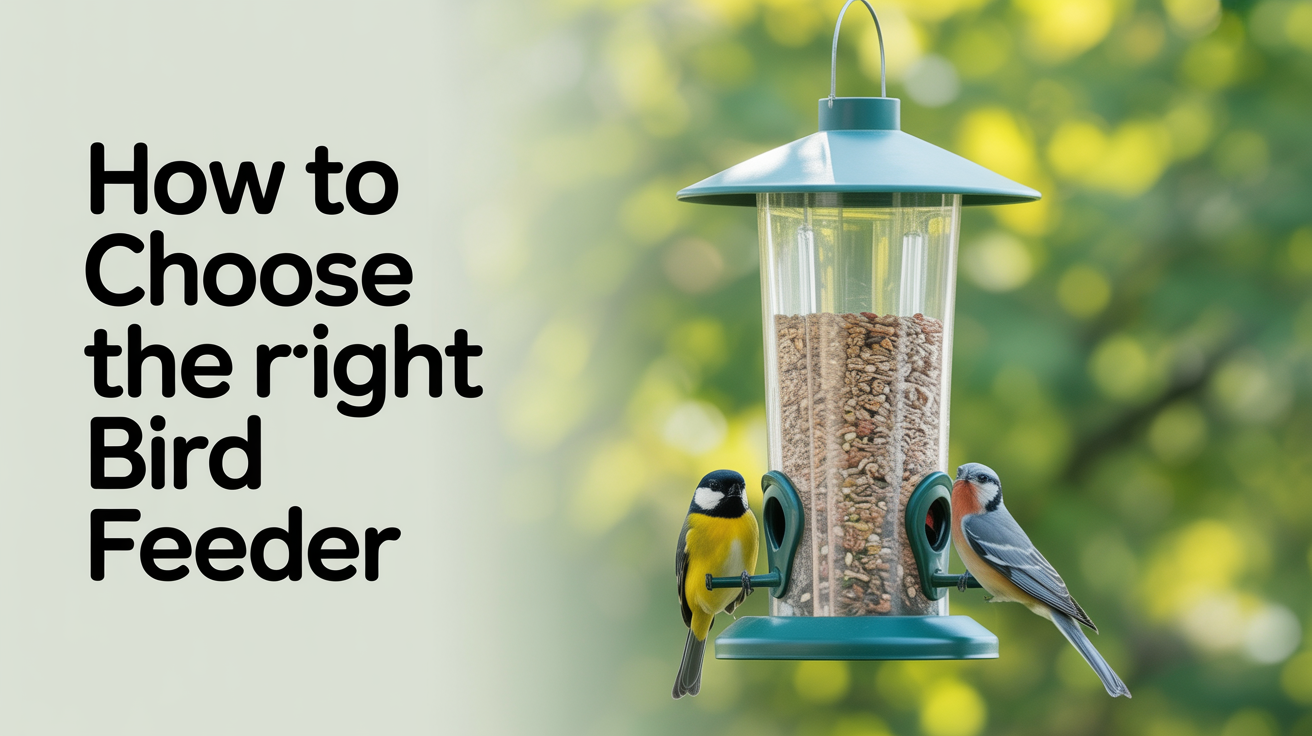
Choosing a bird feeder comes down to three things: which birds you want to see, what seed you plan to use, and how much maintenance you're willing to do. Get those three in alignment and almost any feeder will work; ignore them and even an expensive model will sit empty.
Match the Feeder to the Bird, Not the Other Way Around
Different species feed at different heights and in different postures. Cardinals and grosbeaks are comfortable perched on a platform or hopper but rarely cling to a narrow tube port. Goldfinches and pine siskins prefer clinging feeders and are drawn to nyjer (thistle) in a tube with tiny ports. Chickadees and nuthatches will visit nearly anything.
A useful starting point: decide which two or three species you most want to attract, then buy for them. If you just set up a general feeder station, black-oil sunflower seed in a hopper or tube covers the widest range of feeder birds in North America, including house finches, chickadees, nuthatches, juncos, and most sparrows.
A few species need specific setups:
- Hummingbirds need a nectar feeder (red reservoir, no yellow parts that attract wasps), cleaned every 2-3 days in warm weather.
- Woodpeckers want suet cages or large tube feeders with tail props; a standard finch tube just doesn't give them room.
- Mourning doves can't use hanging feeders; they need a platform or the ground.
- Orioles visit orange halves and grape-jelly feeders, not seed.
Understand the Main Feeder Types
Before buying, it helps to know what you're comparing. Each design has genuine tradeoffs.
| Feeder type | Best seed(s) | Works for | Watch out for |
|---|---|---|---|
| Tube (small ports) | Nyjer, fine sunflower chips | Finches, redpolls, siskins | Clogs when wet; hard to clean deep tubes |
| Tube (large ports) | Black-oil sunflower, safflower | Chickadees, finches, nuthatches | House sparrows monopolize them |
| Hopper / house | Sunflower, mixed, safflower | Cardinals, jays, woodpeckers | Seed can spoil in the base if it gets damp |
| Platform / tray | Almost anything, millet on ground | Doves, juncos, sparrows, towhees | No weather protection; needs frequent raking |
| Suet cage | Suet cakes, dough | Woodpeckers, creepers, wrens | Suet goes rancid above ~80°F unless it's rendered no-melt |
| Nyjer sock | Nyjer seed | American goldfinch, lesser goldfinch | Degrades in UV, replace every season |
| Nectar feeder | Sugar water (4:1 water:sugar) | Hummingbirds, orioles | Must be cleaned every 2-3 days in summer |
For a deeper look at how these types work in practice, see Tube, Hopper, Platform, and Suet: Feeder Types Explained.
Evaluate Capacity vs. Cleaning Frequency
A large hopper holding 5 lbs of seed sounds convenient, but if birds eat slowly or the weather turns wet, that seed can clump, mold, or ferment at the bottom before it's gone. Moldy seed can harm birds.
As a general rule:
- High-traffic yards (20+ birds daily in peak season) can handle 3-5 lb capacity hoppers and will burn through seed fast enough to keep things fresh.
- Low-traffic yards or new feeders do better with smaller capacity (1-2 lbs) until you know the demand. Refilling more often is less wasteful than throwing out spoiled seed.
- Nyjer feeders are particularly prone to staling. Nyjer loses its oil and birds stop eating it, so a small tube that empties every week beats a large one that sits for a month.
Budget roughly $1.50-4.00 per pound for quality black-oil sunflower, and $4.00-7.00 per pound for nyjer, so you're not over-filling what won't get eaten.
Squirrel Resistance and Placement
Squirrel-resistant feeders fall into two main categories: weight-sensitive feeders that close ports when a squirrel lands, and caged feeders where a wire cylinder allows small birds through but blocks larger animals. Both work, with honest caveats:
- Weight-sensitive feeders (Squirrel Buster, Droll Yankees Flipper, etc., typically $40-90) work well on a hanging hook with 10 feet of clearance from any jumping surface. If squirrels can approach from above, they bypass the mechanism.
- Caged feeders are more foolproof for squirrels but also exclude larger desirable birds like cardinals and grosbeaks. Fine for a finch or chickadee-focused setup.
- A baffle on the pole is often more effective than a squirrel-proof feeder body. A smooth metal cone or wrap baffle, mounted 4-5 feet off the ground with the feeder at least 10 feet from any launchable branch, stops most squirrels regardless of feeder design.
No solution is absolute. A determined squirrel on a free-hanging feeder with enough overhead clearance will eventually find a way. At that point the honest options are accepting some seed loss or switching to safflower, which most squirrels dislike (most birds don't mind it).
Material and Weather Durability
Polycarbonate plastic is the most common and fine for most uses. It's lightweight, easy to see into, and typically lasts 3-7 years before UV degradation makes it brittle. Avoid clear soft plastic, which cracks fast.
Metal feeders (powder-coated steel, copper) hold up better long-term and are easier to clean, but they're heavier and more expensive. Worth it for a permanent station you plan to keep for a decade.
Wood feeders look attractive but need more maintenance. If the roof isn't well-sealed, water infiltrates the joints and the feeder rots in a few seasons. Untreated cedar holds up better than pine.
For easy cleaning (which matters for bird health), look for:
- Removable or slide-out trays
- Wide-mouth tubes (narrow tubes accumulate wet seed at the bottom and are nearly impossible to brush out)
- Smooth interior surfaces without corners that trap debris
A feeder you can disassemble and run under hot water every two weeks will serve birds better than an elaborate one that never gets cleaned.
Picking a Feeder for a Specific Goal
If you have a single specific goal, here's the short version:
"I want cardinals." A medium hopper or platform feeder, black-oil sunflower or safflower seed, mounted 4-6 feet off the ground near a shrubby edge. Cardinals don't like exposed, open areas with no nearby cover.
"I want goldfinches." A nyjer tube or sock feeder, hung where you can watch from a window. Stock fresh nyjer. Stale seed is the most common reason goldfinch feeders fail. The birds are there; they're just not interested in old seed.
"I want to attract the most species possible." Two feeders rather than one: a tube or hopper with black-oil sunflower for the perching birds, and a suet cage for the woodpeckers and creepers. Add a platform with millet for the ground feeders. More feeder stations also reduce competition and aggression at each one. See The Best Bird Seed Types and What Each One Attracts for the full seed-to-species breakdown.
"Birds stopped coming and I don't know why." See Why Birds Aren't Coming to Your Feeder, and How to Fix It. The most common culprits are stale or moldy seed, seasonal shifts in bird distribution, and predators (hawks or cats) that have spooked the flock.
Frequently Asked Questions
How much should I spend on a bird feeder?
A functional tube or hopper feeder runs $15-35. Squirrel-resistant models with weight-sensitive closures are typically $40-90. You don't need to spend a lot. A plain $18 tube feeder with fresh nyjer will attract more goldfinches than a $70 decorative house feeder stocked with cheap mixed seed. Seed quality matters more than feeder price.
Can I have multiple feeders in the same yard?
Yes, and multiple feeders often work better than one large one. Spreading seed across two or three stations reduces competition; dominant species like house sparrows and house finches will camp on a single feeder and chase others away. Placing feeders at different heights and distances from cover also gives timid species somewhere to feed undisturbed.
Do bird feeders need to be cleaned, and how often?
Every two weeks is a reasonable baseline in mild weather; weekly during hot, humid summers when seed and nectar spoil faster. Nectar feeders need cleaning every 2-3 days when temperatures are consistently above 80°F. Wipe down all surfaces, clear any wet or moldy seed from the base, and rinse with hot water. A weak bleach solution (1 part bleach to 9 parts water) can be used occasionally for deeper disinfecting, followed by a thorough rinse and air-dry.
What's the difference between a hopper feeder and a platform feeder?
A hopper has enclosed sides with seed dispensing through ports or open edges at the bottom; gravity feeds seed down as birds eat. A platform is a flat open tray with no enclosure. Hoppers keep seed drier and hold more volume; platforms let birds approach from any angle and can accommodate species (like doves) that won't perch on a closed hopper, but they offer no weather protection and need more frequent cleaning.
Is it okay to put a bird feeder near a window?
Yes, with one caveat: position it either within 3 feet of the glass or more than 30 feet away. Feeders in the 10-30 foot range are the window-strike danger zone, because birds build enough speed to injure themselves when flushed. A feeder mounted directly on the glass or just outside it means birds can't accelerate to a dangerous velocity before they reach the window.