Attracting Birds
How to Attract More Birds to Your Yard
Practical steps to get more wild birds visiting your yard, covering food, water, shelter, and plants that actually work for your region.
If you want to know how to attract birds to your yard, the short answer is: give them what they need to survive. Food, clean water, cover from predators, and places to nest. Set up even two or three of these reliably and birds will find you, often within days.
The following sections walk through each element in practical detail, with specific species, seed types, plant names, and price ranges so you can make decisions that fit your yard and budget.
Start with the Right Food for the Birds You Want
Seed mixes sold in grocery stores are often padded with milo, oats, and wheat that most North American songbirds drop on the ground and ignore. Buying the right seed from the start means less waste and faster results.
The single most productive feeder setup for a typical suburban yard is a tube feeder loaded with black-oil sunflower seed (roughly $1.00–$1.50/lb in 20 lb bags) paired with a suet cage. Black-oil sunflower attracts Northern Cardinals, Black-capped and Carolina Chickadees, White-breasted Nuthatches, House Finches, and most woodpeckers. Suet (especially plain beef suet or high-fat cakes without fruit fillers) brings in Downy, Hairy, and Red-bellied Woodpeckers year-round and is particularly important from October through March when insects are scarce.
For a broader range of visitors, consider adding:
| Seed / Food | Top Species Attracted | Notes |
|---|---|---|
| Black-oil sunflower | Cardinals, chickadees, nuthatches, finches | Best all-around; hull-less chips reduce mess |
| Nyjer (thistle) | American Goldfinch, Pine Siskin, Common Redpoll | Needs a finch sock or fine-port tube; goes stale fast |
| Safflower | Northern Cardinal, Mourning Dove, House Finch | House Sparrows and squirrels largely ignore it |
| Shelled peanuts | Blue Jay, Tufted Titmouse, woodpeckers, Carolina Wren | High cost ($3–5/lb) but very effective; buy roasted, unsalted |
| Suet cakes | Woodpeckers, nuthatches, Brown Creeper, wrens | Avoid fruit or peanut-butter varieties in summer heat; they melt |
| Mealworms (dried) | Eastern and Western Bluebird, American Robin, Gray Catbird | Most effective during spring nesting; fresh mealworms outperform dried |
A word on feeders themselves: cleanliness matters more than brand. Wet seed grows mold within a few days in humid weather and can sicken birds. Empty and wipe feeders every 1–2 weeks, more often after rain. A 10% bleach solution (1 part bleach to 9 parts water) kills most pathogens; rinse thoroughly and let dry before refilling.
See how to choose the right bird feeder for guidance on matching feeder style to the birds and seeds you're targeting.
Add a Water Source — It Often Outperforms Feeders
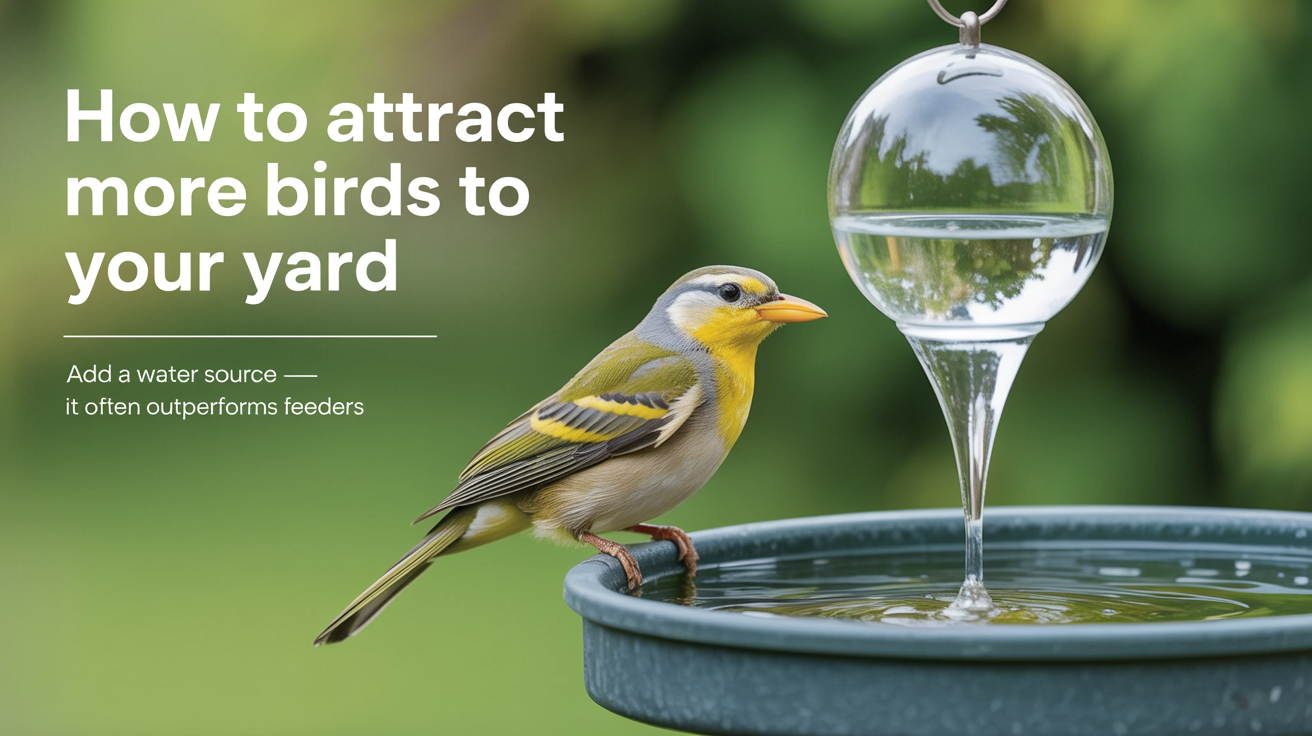
Water is the fastest way to get more birds in your yard, including species that never visit seed feeders: American Robins, warblers during migration, Cedar Waxwings, thrushes, and most sparrows. These birds eat mainly insects or fruit, so a feeder does nothing for them. A birdbath does.
A few specifics that make a real difference:
Depth and texture. Most birds prefer 1–2 inches of water with a gradual slope and a rough basin surface for grip. A bath that's 4 inches deep everywhere will see far less use. If your bath is too deep, place flat stones or a few large pebbles inside to create shallower sections.
Moving water. A dripper, mister, or solar-powered fountain will attract two to three times as many species as a still bath. Birds hear the dripping and home in on it, particularly warblers and thrushes that would otherwise fly right over a suburban yard. Drippers cost $15–40 and attach to a garden hose.
Placement. Position the bath 10–15 feet from dense shrubs or brush, close enough for birds to retreat quickly from a cat or hawk, but not so close that a predator can crouch undetected right at the water's edge. Avoid placing it directly under a feeder; falling hulls and droppings foul the water quickly.
Winter. A heated bath ($30–70 for a thermostatically controlled basin or immersion heater) keeps water open when everything else is frozen and draws species like Carolina Wrens and American Tree Sparrows that might otherwise move through without stopping.
Change the water every 2–3 days regardless of season. Stagnant water breeds mosquito larvae in warm months and can accumulate bacteria year-round.
For a deeper look at setup and placement, bird baths: how to attract birds with water covers material choices and seasonal care in more detail.
Plant Native Vegetation for Food and Shelter
Feeders are a supplement. Native plants are the engine. A yard with diverse native shrubs, trees, and perennials will hold more species, more consistently, than any feeder setup alone.
The reason is structural: birds need cover from predators, insects to feed their nestlings (even seed-eating species feed their chicks almost exclusively on caterpillars and soft insects for the first weeks of life), and fruit and seed heads through late summer and winter. Non-native ornamentals provide little of this.
A few high-value native plants by region:
Eastern US:
- Ilex verticillata (Winterberry Holly): dense winter fruit clusters used by American Robins, Eastern Bluebirds, and waxwings
- Cornus sericea (Red-twig Dogwood): fruit eaten by 36+ species; thicket structure provides nesting cover for Song Sparrows and Gray Catbirds
- Quercus spp. (Oaks): support 500+ caterpillar species; no other genus comes close for feeding nestlings
Western US:
- Sambucus mexicana (Blue Elderberry): berries consumed by dozens of species from tanagers to thrushes
- Artemisia tridentata (Sagebrush): critical winter cover and foraging habitat for sparrows and towhees in drier yards
- Ceanothus spp. (Wild Lilac): nitrogen-fixing, drought-tolerant, and used by multiple sparrow and warbler species
General principle: prioritize structural diversity. A mix of a canopy tree, mid-height shrubs (4–10 feet), and dense low-growing ground cover gives birds three distinct zones to forage and hide in. A yard of closely mowed lawn and ornamental yews provides almost none.
Even a single native shrub in a small yard makes a difference. Start with whatever is locally available; native plant societies in most states sell regional species at annual sales in April and May for $5–15 per plant.
For a detailed plant-by-plant breakdown, native plants that attract birds covers species lists by region with specific notes on which birds use them.
Manage Your Yard to Reduce Hazards
Getting more birds into your yard is only useful if they survive the visit. Several common yard features reduce bird populations rather than supporting them.
Windows. An estimated 600 million birds die from window collisions in the United States each year. If your yard has large glass doors or picture windows, this is the highest-impact hazard to address. External window films with a UV-reflective pattern (birds see UV; humans mostly don't) have been tested in controlled studies and reduce strikes by 70–90%. Strips of exterior tape placed 2 inches apart across the glass surface work similarly. Moving feeders to within 3 feet of windows (so birds don't build flight speed before impact) or more than 30 feet away (enough distance to avoid the reflection zone) also helps.
Cats. Free-roaming cats are the largest direct human-caused source of bird mortality in North America, accounting for an estimated 1.3–4 billion birds per year. Keeping cats indoors, or in an enclosed catio, is the most effective single action a backyard birder can take to protect the birds they attract.
Pesticides. Broad-spectrum insecticides, including neonicotinoids used as systemic seed treatments, reduce the insect base that birds depend on, particularly during nesting season when caterpillars and beetles are the primary food source for nestlings. Spot-treating specific problem plants is far preferable to blanket lawn and garden spraying.
Leaf cleanup. Leaving leaves under shrubs and along fence lines over winter provides foraging habitat for Fox Sparrows, Eastern Towhees, and Hermit Thrushes, which scratch through leaf litter for overwintering insects and seeds. A perfectly raked yard strips this resource completely.
Set Feeder Placement and Timing Strategically
Where you put feeders matters almost as much as what you put in them.
Place feeders 10–12 feet from cover (dense shrubs or a brush pile) so birds can retreat fast if a Sharp-shinned or Cooper's Hawk comes through. Both species have learned that feeders are hunting grounds. At the same time, keep feeders far enough from your windows to avoid collision risk (see above).
Height is less critical than commonly assumed. Most ground-feeding birds (juncos, native sparrows, Mourning Doves) will use a low platform at 12–18 inches; perching birds like chickadees and titmice work tube feeders hung at 4–6 feet. The real rule is consistency: birds are more likely to find and return to a feeder that stays in the same location.
Timing your setup before migration waves can pay off. In the eastern US, filling nyjer and sunflower feeders by late March positions you for American Goldfinches in breeding plumage arriving April through May. In the West, hummingbird feeders should be out by mid-March along the Pacific coast and late April at higher elevations, before male Rufous or Anna's Hummingbirds arrive.
If you put up a new feeder and see no birds for the first week or two, don't assume something is wrong. Birds need time to discover new food sources, especially in yards that haven't had feeders before. Placing a brush pile or laying out a patch of leaf litter nearby speeds up discovery by giving birds a reason to investigate the area.
Frequently Asked Questions
How long does it take for birds to find a new feeder?
In a yard with existing vegetation and nearby wild areas, expect the first visitors within a few days to two weeks. In a sparse or newly landscaped yard, it can take four to six weeks. Black-capped or Carolina Chickadees are usually the first to investigate, followed by nuthatches and finches. Once regulars establish a routine, other species follow.
Do I need to feed birds year-round, or just in winter?
You can feed year-round if you want to, but it isn't necessary. The birds that rely most on feeders (White-throated Sparrows, Dark-eyed Juncos, Pine Siskins) are largely winter residents. Summer feeders do attract breeding birds and may help them during drought or late cold snaps, but healthy birds with access to native plantings can find enough food on their own during warm months. If you feed in summer, check and clean feeders more often; heat speeds mold growth significantly.
What is the single best thing I can do to get more birds?
If you have nothing now, add a birdbath with a dripper before anything else. Water draws species that ignore feeders entirely, works year-round, and requires less ongoing investment than a seed operation. If you already have a bath, the next highest-return action is planting a native shrub that provides cover and food. A Winterberry Holly, a Red-twig Dogwood, or a native serviceberry (Amelanchier spp.) will draw more species over its lifetime than any feeder.
Will feeders make birds dependent so they can't survive without them?
No. Research on Black-capped Chickadees found that supplemental feeders supply roughly 20–25% of their winter caloric intake; the rest comes from cached food and wild foraging. If you stop filling feeders, birds shift their foraging patterns without harm. That said, stopping abruptly during a severe cold snap (sustained temperatures below 0°F) can stress birds that have begun relying on a predictable food source during that specific weather event.
How do I attract specific species like bluebirds or hummingbirds?
Bluebirds rarely use seed feeders. They need open habitat (short grass or meadow), mealworms (live or dried, offered in a shallow tray), and a nest box with a 1.5-inch entrance hole mounted 4–6 feet high on a pole with a predator baffle. Hummingbirds need a clean nectar feeder (1 part plain white sugar to 4 parts water; no red dye) and flowering plants like native Salvia, Monarda, and Penstemon. Each species requires a specific combination of habitat, food type, and nesting opportunity — not just a different kind of seed.