Identifying Birds
Confusing Lookalike Birds and How to Tell Them Apart
Four classic lookalike bird pairs that trip up backyard birders, plus the exact field marks you need to sort them out for good.
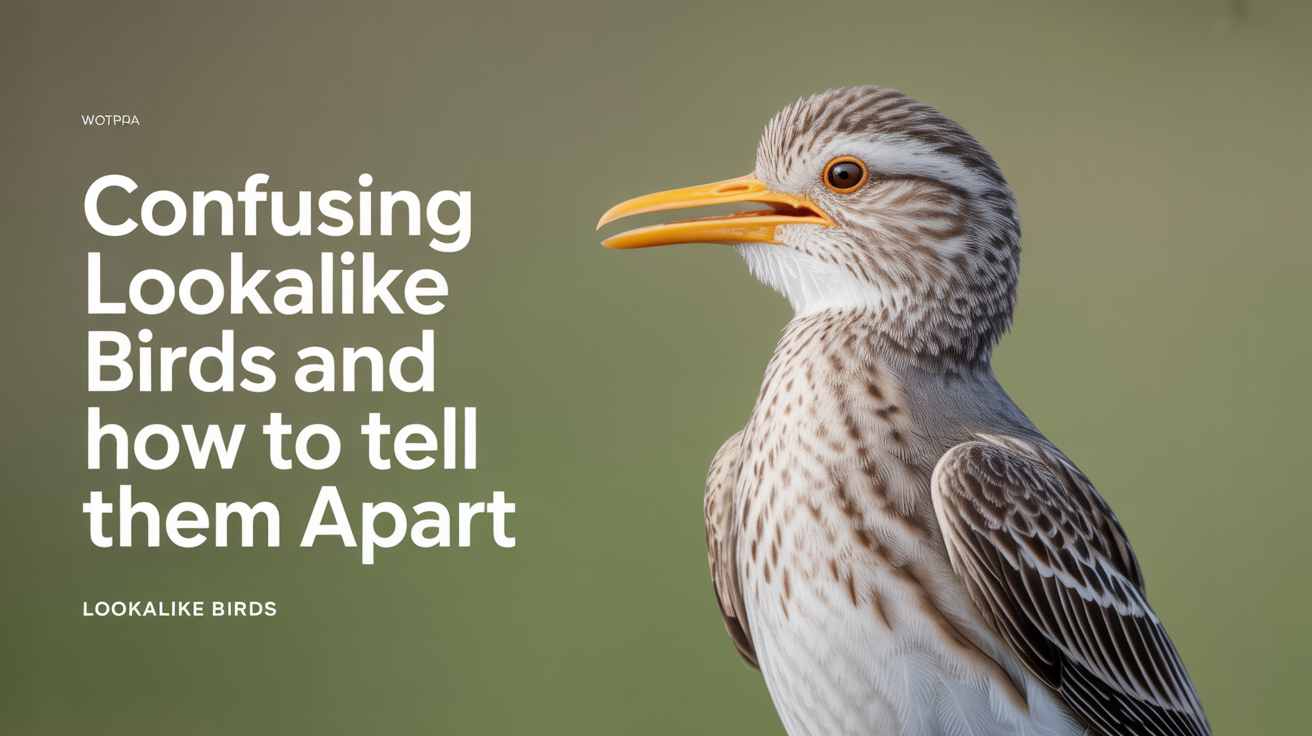
Lookalike birds cause more bird id confusion than almost anything else in backyard birding. Here are four pairs that stump most beginners, along with the specific field marks that crack each one.
Downy Woodpecker vs. Hairy Woodpecker
These two black-and-white woodpeckers visit the same suet feeders and work the same tree trunks, making them one of the most common sources of hard to identify birds at feeders. Side by side, the size difference is obvious: the Downy is sparrow-sized at about six to seven inches, while the Hairy is closer to a robin at nine to ten inches. The problem is that you rarely see them together.
The bill is the key. Look at the bill length relative to the bird's head. On a Downy Woodpecker, the bill is short and stubby, roughly a third as long as the head is wide. On a Hairy Woodpecker, the bill is long, stout, and nearly as long as the head from front to back. If the bill looks like it belongs on a miniature jackhammer, you are looking at a Hairy.
A second reliable mark: the outer tail feathers. Both species have white outer tail feathers, but on a Downy those feathers show black barring or spots. The Hairy's outer tail feathers are clean white with no markings at all. This detail is easiest to see when the bird is clinging vertically to a tree and has fanned its tail slightly.
Sound also helps. The Downy gives a soft, gentle "pik" call. The Hairy's call is a sharp, loud "peek" that carries across the yard. Once you've heard both, the difference sticks quickly.
House Finch vs. Purple Finch
This pair sits near the top of most lists of similar looking birds. Both are streaky finches with reddish coloring on the males, and both show up at tube feeders and platform feeders regularly. Bird id confusion here is completely understandable.
For the males: The classic description of a Purple Finch is a bird that looks as though it was dipped in raspberry juice. The red is deep and rich, extending from the head down through the back and wings, with the streaking blending into the overall color. A male House Finch has red limited to the forehead, crown, throat, and rump. His flanks are streaked brown, and there is a clear contrast between the red areas and the brown body. If you can see the back, House Finch shows obvious brown streaks; Purple Finch's back looks more uniformly colored.
For the females: This is where lookalike birds really cause frustration. Female House Finch is a plain streaky brown bird with no strong facial markings. Female Purple Finch is also streaky brown, but she has a bold white eyebrow stripe and a dark brown cheek patch that frames a pale face. The contrast on her face is strong enough to catch your eye at feeder distance.
Bill shape adds one more clue: Purple Finch has a slightly curved, robust bill. House Finch has a rounder, thicker bill that looks a bit blockier overall.
| Feature | House Finch (male) | Purple Finch (male) |
|---|---|---|
| Red extent | Forehead, crown, throat, rump | Head, breast, back, wings |
| Flanks | Brown streaks | Minimal streaking |
| Back | Brown with streaks | Raspberry wash throughout |
| Female face | Plain, no strong markings | Bold white eyebrow stripe |
For a deeper look at these two alongside the American Goldfinch, see identifying backyard finches: goldfinch, house, and purple.
Cooper's Hawk vs. Sharp-shinned Hawk
Neither bird will visit a seed feeder, but both will come to a feeder yard to hunt the birds that do. They're among the hardest to identify birds in North America, and experienced birders sometimes disagree on individual sightings. That said, backyard birders can learn a handful of marks that resolve most encounters.
Size: A Cooper's Hawk is roughly crow-sized. A Sharp-shinned is closer to a jay. The trouble is that female Sharp-shinneds overlap in size with male Cooper's, so size alone will mislead you on a lone bird. Use it as supporting evidence rather than a final answer.
Tail shape: In flight or when perched with a fanned tail, Cooper's Hawk shows a rounded tail tip. Sharp-shinned Hawk shows a squared-off tip that can look slightly notched in the middle. This is the most-cited mark, though tails can look misleading depending on angle and how worn the feathers are.
Head projection in flight: Watch how much of the head sticks out ahead of the wings. Cooper's Hawk has a large, round head that projects noticeably past the leading edge of the wing. Sharp-shinned has a smaller head that barely clears that line. Some birders describe it as Cooper's looking like a flying cross, while Sharp-shinned looks more like a flying T.
Flight style: Cooper's has a somewhat measured, deliberate flap-flap-glide pattern. Sharp-shinned is quicker and choppier with faster wingbeats. Both use the same general accipiter style, but the tempo differs once you've watched each bird a few times.
When either species appears, the feeder yard goes quiet. Chickadees and sparrows freeze or scatter into cover. That behavioral cue often signals a hawk's arrival before you've spotted it.
House Sparrow vs. Native Sparrows
House Sparrows are non-native birds introduced to North America in the 1800s, and their plain brown appearance creates bird id confusion with several native sparrow species. Getting solid on the House Sparrow's features actually makes the native species easier to pick out.
Male House Sparrow has a chestnut nape, gray crown, black bib, and a gray cheek. His back is brown with black streaks, and his wings show a rusty wash. The black bib is the most reliable identifier; no common native sparrow has one.
Female House Sparrow is trickier. She's dull buffy-brown with a faint pale eyebrow and a plain face with no strong markings at all.
Here's how three common native sparrows differ:
-
Song Sparrow: Heavily streaked on the breast, with the streaks converging into a central spot on the chest. The tail is long and rounded, often pumped up and down in flight. Song Sparrows sing year-round, which makes them easy to pin down by ear even when you can't see them clearly.
-
White-throated Sparrow: A clean white throat patch is the giveaway. Adults also show yellow spots between the eye and the bill (the lores) and either a white- or tan-striped crown. This species visits feeders readily from fall through spring across most of the eastern half of the country.
-
Chipping Sparrow: In breeding plumage, the rufous cap, white eyebrow, and black eye line make it distinctive. In winter, the cap dulls and the face becomes blurrier, pulling it closer in appearance to other sparrows.
For a full rundown of sparrow ID at the feeder, how to tell common sparrows apart covers more species and seasonal variation in detail.
If you're still building your baseline knowledge of which birds show up in the average backyard, how to identify common backyard birds is a practical starting point before drilling down into the trickier pairs.
Habits That Speed Up ID
A few practices that make a real difference once you're at the window with binoculars:
Study the bird before reaching for the field guide. Spend 30 seconds looking at the bill, the face, the back, and the tail. Training your eye to gather details in sequence is more useful than flipping through pages while the bird flies off.
Use one feature as an anchor. For Downy vs. Hairy, that's bill length. For House vs. Purple Finch females, that's the eyebrow stripe. For Cooper's vs. Sharp-shinned, that's head projection. Lock onto one reliable mark and let the others confirm.
Pay attention to season. Sharp-shinned Hawks peak at feeders during fall migration; Cooper's are more likely to stick around through winter. Purple Finches tend to move through in fall and winter in most regions; House Finches are year-round residents. Seasonal context narrows the field before you even raise the binoculars.
Listen. Calls separate many similar looking birds faster than visual marks. Downy vs. Hairy is a clear example, but the same applies across most lookalike pairs. A few hours with a birding app's sound library will pay off quickly at the window.
Frequently Asked Questions
What's the single fastest way to tell a Downy from a Hairy Woodpecker?
Look at the bill length relative to the head. A Downy's bill is stubby and short; a Hairy's bill is long and stout, nearly as long as the head is wide. This works at feeder distance without needing a comparison bird nearby.
Why do female finches look so different from male finches?
Female finches are streaky brown because that coloring conceals them on the nest. Males have brighter plumage for mate attraction. The difference means you effectively need to learn two separate birds for each species.
Are Cooper's Hawks and Sharp-shinned Hawks a threat to feeder birds?
They do prey on small birds, including species that visit feeders. This is normal predator behavior, not a problem that needs solving. If you prefer not to watch it happen, taking feeders down for a few days will usually move the hawk along to another hunting area.
Do House Sparrows compete with native sparrows?
House Sparrows compete mainly with cavity-nesting birds such as bluebirds and Tree Swallows for nest sites. At a seed feeder, they share space with native sparrows, but the sharpest competition is a nest-box concern rather than a feeder concern.
How do I improve at bird ID generally?
Consistent observation beats cramming field guides. Pick one feeder and watch it for 15 minutes a day. As you build a mental library of common species, the lookalike pairs get easier to handle because you already know what each bird typically looks like in your yard.