Identifying Birds
How to Identify the Owls Calling in Your Backyard at Night
Learn to identify backyard owls by call pattern, rhythm, and shape, plus how to listen at night without stressing a nesting pair.
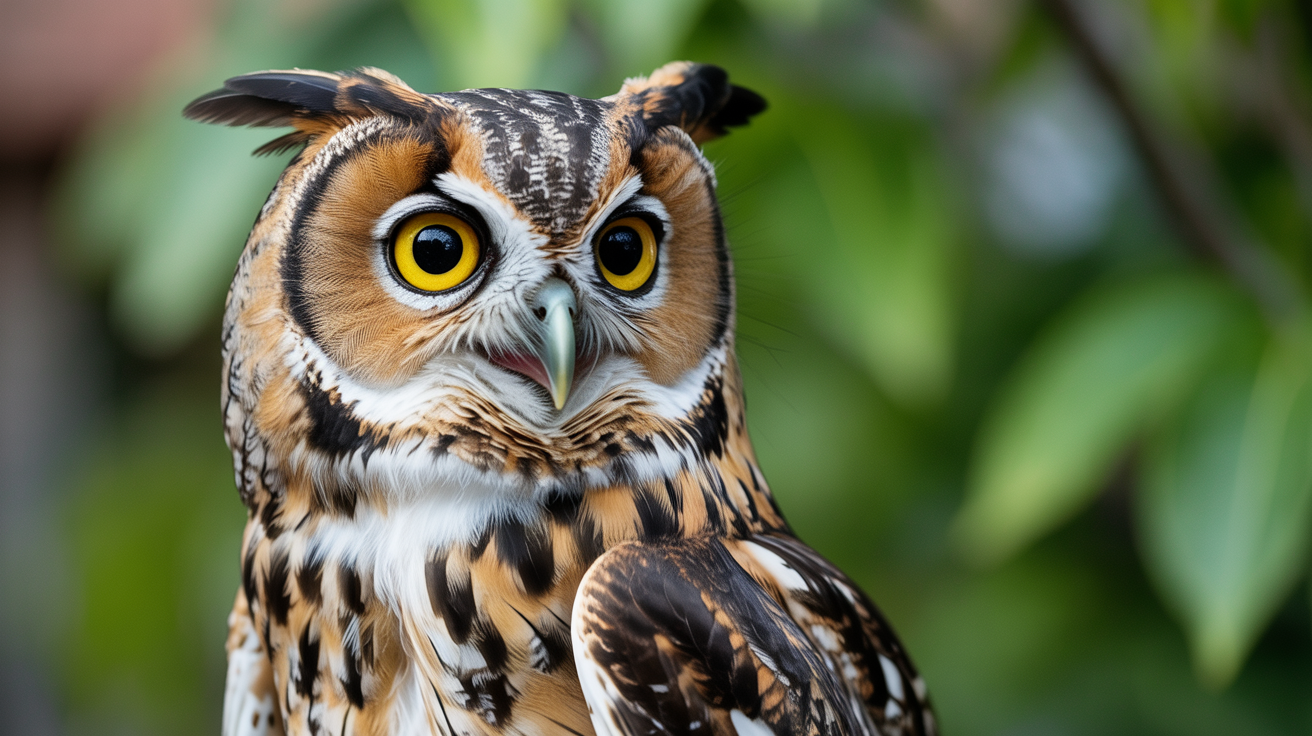
You're standing in the dark by the back door, coffee going cold, trying to place that low hooting coming from somewhere past the fence line. This is one of the most common questions in backyard birding: something is calling after sunset, you can't see it, and every hoot sounds roughly the same until you know what to listen for. Learning to identify backyard owls comes down almost entirely to your ears. Unlike daytime birds, where color and shape do most of the work, owls are usually a voice in the dark long before they're a shape on a branch.
The good news is that most yards, even in fairly built-up neighborhoods, only host a handful of owl species. Once you know the short list and how each one actually sounds, the guessing mostly stops.
Which Owls Actually Show Up in Backyards
Across most of the continental US, four species make up nearly all backyard and neighborhood owl encounters.
Great Horned Owl is the big one, a heavy-bodied owl with prominent ear tufts that shows up almost anywhere there's a mix of trees and open ground, including plenty of suburban blocks. It's the owl most people picture when they hear the word.
Barred Owl favors areas with more mature trees and often some water nearby, like a wooded ravine or a creek corridor behind a subdivision. It has expanded its range considerably over the past few decades and is now a common backyard visitor in a lot of places that didn't have it a generation ago.
Eastern Screech-Owl (or its western counterpart in the western half of the country) is small, common, and probably under-detected because its calls don't sound like a classic hoot at all. It will happily nest in a yard with a few decent-sized trees or a nest box.
Barn Owl is more of a farmland and open-country bird, but it does turn up around rural and semi-rural properties, old barns, and agricultural edges. Its call is unmistakable once you've heard it, mostly because it isn't a hoot.
There are other owls in specific regions (Long-eared, Short-eared, Northern Saw-whet), but for a typical yard, those four cover the overwhelming majority of what you'll actually hear.
Telling Owls Apart by Call Pattern and Rhythm
Because owls are rarely seen well after dark, rhythm and pattern do most of the identification work, the same way they would for identifying birds by their songs and calls during the day. Pitch matters less than you'd think. What matters is how the sound is spaced and grouped.
Great Horned Owl: slow, deep, evenly spaced
The classic call is a series of soft, low hoots, usually four to six of them, spaced out at a steady, unhurried pace: something like "hoo, hoo-hoo, hoo, hoo." It's deep enough that you sometimes feel it more than hear it clearly from a distance. Pairs will often call back and forth, and the female's voice is usually a bit higher than the male's. If the hooting sounds patient and deliberate, like nobody's in a hurry, that's a strong Great Horned signal.
Barred Owl: choppy, rhythmic, almost sentence-like
This is the owl behind the phrase "who cooks for you, who cooks for you all," and once you've heard that cadence described that way, it's hard to unhear. It's a rhythmic, barking series of hoots grouped in twos, with a distinctive rise and fall that sounds almost like a question. Barred Owls also make a wider range of other sounds, including cackles, gurgles, and duets between paired birds that can sound genuinely strange the first time you hear them.
Eastern Screech-Owl: a whinny or a trill, not a hoot at all
This is the one that trips people up, because the name suggests a screech and the actual calls don't sound anything like the movie-style "screech" sound effect. The two common calls are a descending, horse-like whinny, and a long, even trill on one pitch, almost like a soft mechanical purr. Both are quiet and easy to miss if there's any background noise. If you're hearing something small and tremulous rather than a hoot, screech-owl is the first thing to consider.
Barn Owl: a harsh, drawn-out screech
True to a different name, this call is a raspy, hissing screech, sometimes described as sounding like tearing cloth or fabric. It's higher-pitched and harsher than anything the other three species make, with no hooting quality at all. If something startles you with a sound closer to a scream than a hoot, and you're in a more open or rural setting, Barn Owl is worth considering.
Secondary Clues When You Do Get a Glimpse
Sound should carry most of the weight, but if you catch a silhouette at dusk or under a porch light, a few visual cues help confirm what you're already hearing.
| Clue | Great Horned | Barred | Eastern Screech-Owl | Barn Owl |
|---|---|---|---|---|
| Size | Large, bulky | Medium-large, rounded | Small, compact | Medium, slender |
| Ear tufts | Prominent | None | Small, often flattened | None |
| Eye color (if visible) | Yellow | Dark brown/black | Yellow | Dark |
| Face shape | Round with tufts | Round, no tufts | Round, no tufts | Heart-shaped, pale |
| Typical perch | Open branch, high | Denser cover, mid-level | Cavity or dense foliage | Barn, silo, tree cavity |
The heart-shaped, almost ghostly pale face of a Barn Owl is genuinely distinctive if you get even a brief look, often in headlights or under an outdoor light. Ear tufts rule out Barred and Barn Owls immediately, since neither has them. Size alone is unreliable in poor light, since a nearby small owl and a distant large one can look about the same, so lean on the call first and treat any visual as a confirmation, not the main clue.
How to Listen Without Disturbing a Territorial Pair
It's tempting to pull up a recording on your phone and play an owl call to see if you get a response, and it does often work, at least once. The problem is that owls are territorial, and a playback call sounds to them like a rival bird has moved into their space. Repeated playback, especially during nesting season, can pull a bird away from incubating eggs or brooding young, or provoke real aggression toward what it thinks is an intruder.
A better approach is patient, passive listening. Step outside around dusk or after dark, stand still for a few minutes away from bright lights, and let your ears adjust. Owls often call most actively in the hour after sunset and again before dawn. If you do want to try a single playback to confirm an identification, keep it to one short clip, not a loop, and don't repeat the exercise night after night in the same spot. If you already know a pair is nesting nearby, it's kinder to skip playback altogether and just enjoy the calls as they come.
Owls vs. Daytime Birds of Prey
It's worth being clear about what this guide does and doesn't cover. This is about species identification for owls specifically, calling at night, mostly by ear. If you're trying to sort out a Cooper's Hawk from a Red-tailed Hawk soaring over your yard at noon, that's a different skill set built around flight shape, wingbeats, and daytime behavior rather than call rhythm in the dark. Our guide to telling backyard hawks and birds of prey apart covers that side of things. The two groups share very little overlap in how you'd actually identify them in the field, since one is a nighttime voice and the other is a daytime silhouette.
If you're newer to backyard birding generally and want a broader foundation before specializing in owls, it also helps to get comfortable with the common backyard birds you'll see by day first. A lot of the same instincts, listening for pattern and rhythm, noting size and shape, checking habitat, carry over directly once the sun goes down.
Frequently Asked Questions
What's the most common owl to hear in a backyard?
Great Horned Owl and Eastern Screech-Owl (or Western Screech-Owl, depending on region) are typically the two most widespread and frequently heard species in residential and suburban yards across the US. Barred Owl is a close third in areas with more mature trees or nearby water.
Why does my owl not sound like a hoot at all?
You're probably hearing a screech-owl. Despite the name, its calls are a descending whinny or a steady trill, not a hoot, and they're often quiet enough to be mistaken for an insect or a distant mechanical sound before you realize it's a bird.
Can I tell owls apart just by pitch, without knowing the pattern?
Not reliably. Pitch varies with individual birds, distance, and how sound carries at night, so pattern and rhythm (spacing between hoots, whether they're grouped, whether it's a hoot versus a screech or whinny) are far more consistent identification cues than pitch alone.
Is it bad to play owl calls on my phone to attract one?
Occasional, brief use is generally considered low-risk, but repeated or nightly playback in the same territory can stress a resident pair, particularly during nesting season, since it mimics a rival bird. If you already know owls are nesting nearby, it's better to just listen.
Do owls call all year, or mostly during a specific season?
Calling activity often increases in late winter and early spring around pairing and nesting, but many owls, especially Great Horned and Barred Owls, will call at least occasionally throughout the year, particularly around dusk and dawn.